 Mineral Matrix: An AI Journey into Earth’s Treasures
The Science Behind Gemstone Colors Explained
Explore the fascinating chemical and physical origins of gemstone colors and what makes them so captivating.
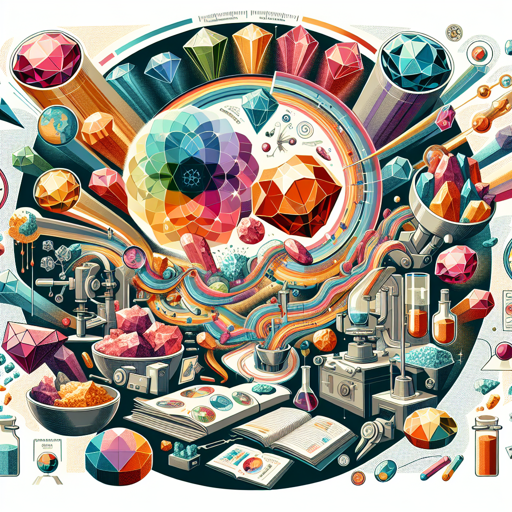
Introduction
Few natural wonders captivate the human eye like the vivid kaleidoscope of colors found in gemstones. From the deep blue of sapphire to the fiery red of ruby and the shimmering greens of emerald, these stones have inspired myths, adorned royalty, and fascinated scientists for centuries. But why do gemstones display such a stunning array of colors? What scientific secrets lie hidden within their crystalline structures? This article embarks on a journey into the heart of minerals to reveal the chemistry, physics, and geology that create the mesmerizing hues of precious gems.
The Nature of Color: A Scientific Foundation
To understand gemstone colors, we must first grasp what color is. Color is not an inherent property of objects but rather a perceptual phenomenon. When light interacts with a material, certain wavelengths are absorbed while others are transmitted or reflected. The combination of wavelengths that reach our eyes determines the color we perceive.
Gemstones interact with light in complex ways, influenced by their atomic structure, impurities, physical defects, and external factors such as light source and viewing angle. Together, these factors orchestrate the brilliant and varied palette that defines gemstone beauty.
“Color is the place where our brain and the universe meet.”
— Paul Klee
How Gemstones Get Their Colors
1. Crystal Structure and Selective Absorption
At the core of every gemstone lies a unique arrangement of atoms in a crystal lattice. This structure dictates how light passes through or is absorbed by the mineral. Pure quartz (SiO₂), for example, is colorless because its lattice does not absorb visible light. However, if certain atoms replace silicon within the lattice or if there are defects, new colors can emerge.
2. The Role of Trace Elements (Chromophores)
Most gemstone colors arise due to trace elements—minute quantities of foreign atoms within the mineral. These elements are called chromophores (from Greek for “color bearers”). Common chromophores include iron (Fe), chromium (Cr), titanium (Ti), manganese (Mn), vanadium (V), and copper (Cu).
Examples:
- Emerald: Its lush green is due to trace amounts of chromium or vanadium in beryl.
- Ruby: The fiery red comes from chromium in corundum.
- Sapphire: Blue sapphire owes its hue to iron and titanium in corundum.
- Amethyst: Purple quartz colored by trace iron and natural irradiation.
3. Color Centers and Physical Defects
Not all gemstone colors are caused by chemical impurities. Sometimes, defects in the crystal lattice—such as missing atoms or misplaced electrons—create “color centers.” These defects can trap electrons that absorb specific wavelengths of light. For example, smoky quartz owes its brownish-gray color to natural radiation creating color centers around aluminum impurities.
4. Iridescence, Play-of-Color, and Optical Effects
Some gems dazzle not with inherent color but with optical phenomena:
- Opal: Famous for its play-of-color, caused by microscopic silica spheres diffracting light.
- Labradorite: Displays labradorescence—a metallic sheen—due to twinning in its crystal structure.
- Moonstone: Exhibits adularescence, a soft glow from light scattering within thin layers.
5. Physical Properties Affecting Color
A. Pleochroism
Certain minerals absorb different wavelengths depending on the viewing direction—a phenomenon called pleochroism. Tanzanite, for example, appears blue, violet, or burgundy when viewed from different angles due to its crystal symmetry.
B. Dispersion
Some gemstones separate white light into spectral colors (like a prism). Diamond’s high dispersion gives it a characteristic “fire.”
Table: Key Chromophores in Popular Gemstones
| Gemstone | Host Mineral | Primary Chromophore(s) | Typical Color(s) | Notable Optical Effects |
|---|---|---|---|---|
| Ruby | Corundum | Chromium (Cr) | Red | Fluorescence under UV light |
| Sapphire | Corundum | Iron (Fe), Titanium (Ti) | Blue | Pleochroism |
| Emerald | Beryl | Chromium (Cr), Vanadium (V) | Green | None |
| Amethyst | Quartz | Iron (Fe) + Irradiation | Purple | None |
| Topaz | Topaz | Iron (Fe), Chromium (Cr) | Blue, Pink, Yellow | None |
| Aquamarine | Beryl | Iron (Fe) | Light Blue | None |
| Alexandrite | Chrysoberyl | Chromium (Cr) | Green/Red (color change) | Strong color change |
| Garnet | Multiple | Iron (Fe), Manganese (Mn), Chromium (Cr) | Red, Green, Orange | None |
| Turquoise | Phosphate | Copper (Cu) | Blue-Green | None |
| Opal | Silica | None (structure) | Multi-color play-of-color | Play-of-color |
Color Change Phenomena: Alexandrite and Beyond
One of the most intriguing gemstone effects is color change, where a gem appears distinctly different colors under various light sources. The best-known example is alexandrite, which shifts from green in daylight to red under incandescent light. This phenomenon occurs due to complex interactions between trace elements and the nature of visible light sources.
The Science in Action: Case Studies
Emerald vs. Aquamarine
Both emerald and aquamarine are varieties of the mineral beryl. Their color differences stem from the chromophore present:
- Emerald: Green due to chromium or vanadium.
- Aquamarine: Blue due to iron.
Their crystal structure is almost identical; it’s just the trace element that gives each its signature hue.
Corundum Family: Ruby and Sapphire
Ruby and sapphire are both corundum (Al₂O₃). The only difference is the impurity:
- Ruby: Chromium = red.
- Sapphire: Iron & titanium = blue; other trace elements can yield pink, yellow, or even green sapphires.
Why Is Quartz So Colorful?
Quartz is one of Earth’s most abundant minerals and can be found in almost every color:
- Amethyst: Purple from iron impurities + irradiation.
- Citrine: Yellow due to iron in a different oxidation state.
- Rose Quartz: Pink from titanium or manganese.
- Smoky Quartz: Grey/brown from natural radiation creating color centers.
Beyond Chemistry: Human Perception and Value
While science explains how gemstone colors originate, human perception determines their beauty and worth. Cultural preferences, rarity, and historical associations all play roles in how we value certain gemstone hues over others.
External Reference
For an authoritative overview of gemstone coloration mechanisms, see this GIA article on the causes of color in gemstones.
Conclusion
The dazzling colors of gemstones are more than just eye-catching displays—they are windows into Earth’s deep chemistry and physics. Whether through trace elements acting as chromophores, structural defects creating color centers, or intricate optical effects like play-of-color or pleochroism, each stone tells a unique story forged over millions of years.
For geology enthusiasts and earth science lovers alike, understanding the science behind gemstone colors deepens our appreciation for nature’s artistry and inspires ongoing exploration into the hidden wonders beneath our feet.
Ready to explore more about minerals and gemstones? Stay tuned for our guides on identifying gems in the field and understanding their geological origins!