 Mineral Matrix: An AI Journey into Earth’s Treasures
How Volcanoes Create New Minerals
Explore how volcanic eruptions form unique minerals, shaping the Earth's geology.
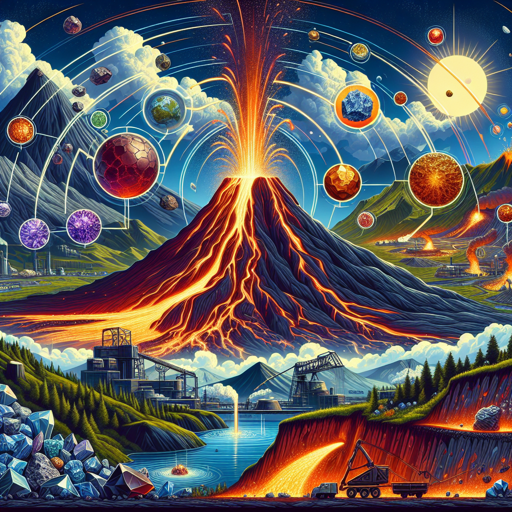
How Volcanoes Create New Minerals
Volcanoes are among the most awe-inspiring and powerful natural phenomena on Earth. They have shaped continents, altered climates, and, perhaps most fascinatingly, created entirely new minerals that enrich our planet’s mineralogical diversity. For geology enthusiasts, educators, students, and curious readers alike, understanding how volcanic activity forms unique minerals offers a window into the Earth’s dynamic processes and the hidden treasures beneath our feet.
Table of Contents
- Introduction
- The Science of Volcanic Activity
- Volcanoes as Mineral Factories
- Types of Minerals Formed by Volcanoes
- Gemstones Born of Fire
- Case Studies: Famous Volcanic Minerals
- The Role of Volcanoes in Mining and Industry
- Table: Comparing Volcanic Minerals
- Quote: The Power of Fire and Stone
- Further Reading
- Conclusion
Introduction
Imagine standing at the edge of a smoking crater, the ground trembling beneath your feet. Far below, molten rock churns and bubbles—an immense reservoir of potential energy. When a volcano erupts, it doesn’t just spew lava and ash; it also unleashes a chemical ballet that creates entirely new minerals. These minerals, often unseen by human eyes for millennia, tell stories of pressure, heat, and transformation.
For those captivated by Earth sciences, volcanoes offer a thrilling glimpse into the forces that shape our world. Their explosive activity is not only responsible for breathtaking landscapes but also for the birth of minerals found nowhere else on Earth. This article explores how volcanic processes create new minerals, the types of minerals produced, and their significance in geology and industry.
The Science of Volcanic Activity
To understand how volcanoes create new minerals, it’s essential to grasp the basics of volcanic activity. Volcanoes are openings in the Earth’s crust that allow magma—molten rock from deep within the mantle—to reach the surface. The journey from mantle to mountain involves intense heat (up to 1,200°C or 2,200°F), high pressure, and interaction with surrounding rocks and gases.
The Life Cycle of a Volcano
- Magma Formation: Deep within the Earth, heat and pressure cause rocks to melt, forming magma enriched with a variety of elements.
- Ascent: Magma rises through cracks in the crust due to its buoyancy.
- Eruption: Pressure builds until the magma escapes explosively or effusively (as lava flows).
- Cooling and Solidification: As lava cools on or near the surface, it crystallizes to form new minerals.
Key Ingredients for Mineral Formation
- Heat: Drives chemical reactions and melts rocks.
- Pressure: Alters mineral structures and stabilities.
- Chemistry: The composition of magma determines which minerals can form.
- Rate of Cooling: Fast cooling favors small crystals; slow cooling allows large crystals to grow.
Volcanoes as Mineral Factories
Volcanoes act as natural factories for mineral creation. As magma cools and solidifies, atoms arrange themselves into ordered patterns—crystals—that become minerals. The variety of conditions present during a volcanic eruption means that a wide array of minerals can form.
Primary vs. Secondary Volcanic Minerals
- Primary Minerals: Form directly from cooling magma (e.g., olivine, pyroxene).
- Secondary Minerals: Form when volcanic rocks are altered by gases or fluids after eruption (e.g., zeolites, opal).
How Magma Chemistry Affects Mineral Formation
Different magmas produce different minerals:
- Basaltic Magma (low silica): Yields olivine, pyroxene, and plagioclase.
- Andesitic/Rhyolitic Magma (higher silica): Favors quartz, feldspar, mica.
Volcanic gases (like sulfur dioxide) can also react with surrounding rocks to form exotic minerals such as sulfur crystals or native copper.
Types of Minerals Formed by Volcanoes
Volcanic environments are responsible for some of the most interesting and beautiful minerals on Earth. Here’s a closer look at several key types:
1. Silicate Minerals
The most abundant group in volcanic rocks:
- Olivine: Green crystals often found in basalt.
- Pyroxene: Dark-colored crystals common in many volcanic rocks.
- Feldspar: Includes both plagioclase (in basalts) and orthoclase (in rhyolites).
- Quartz: Forms in high-silica magmas.
2. Oxide Minerals
- Magnetite: An iron oxide giving basalt its magnetic properties.
- Ilmenite: A titanium oxide important in industry.
3. Sulfide Minerals
Formed from volcanic gases:
- Pyrite (“Fool’s Gold”)
- Chalcopyrite
4. Native Elements
Some volcanoes emit native metals:
- Sulfur: Bright yellow crystals near fumaroles.
- Copper: Rarely forms pure metallic deposits around volcanic vents.
5. Zeolites and Other Secondary Minerals
When volcanic rocks interact with groundwater:
- Zeolites: Used as water softeners and industrial catalysts.
- Opal: Precious varieties can form in volcanic ash beds.
Gemstones Born of Fire
Volcanic activity isn’t just about drab rocks—it’s also about dazzling gemstones. Many gems owe their origins to volcanic processes.
Peridot (Olivine)
Peridot is one of the few gemstones that occurs in only one color—an enchanting olive green. It forms deep within the mantle and is brought to the surface by basaltic lava.
Obsidian
Formed when felsic lava cools rapidly with minimal crystal growth, obsidian is a natural volcanic glass prized for its sharpness and beauty.
Opal
Volcanic ash beds often host opals—hydrated silica minerals known for their play of color.
Other Gems
- Garnet
- Spinel
- Moonstone
These gems form in the high-pressure, high-temperature conditions created by volcanic activity or in the aftermath as hydrothermal fluids circulate through cooling lava.
Case Studies: Famous Volcanic Minerals
Let’s explore some iconic locations where volcanic activity has given rise to unique minerals:
1. Mount Erebus (Antarctica)
Home to rare minerals like Erebusite (a sodium-calcium sulfate) found only in its volcanic fumaroles.
2. Kīlauea (Hawaii)
Produces large amounts of olivine sands—a beautiful green mineral that collects on certain Hawaiian beaches.
3. Mount Vesuvius (Italy)
Over centuries, Vesuvius has produced more than 250 different mineral species—more than any other single volcano—including rare zeolites and unique sulfur crystals.
4. Tolbachik Volcano (Russia)
A paradise for mineralogists, Tolbachik’s lava flows and fumaroles have produced over 100 new minerals found nowhere else on Earth.
The Role of Volcanoes in Mining and Industry
Volcanic minerals aren’t just scientifically fascinating—they’re also economically vital. Many mining operations target deposits formed or influenced by volcanic activity.
Volcanogenic Massive Sulfide Deposits (VMS)
Ancient submarine volcanoes created these rich sources of copper, zinc, lead, gold, and silver—crucial for modern technology.
Industrial Applications
- Zeolites from volcanic tuff are used in water purification.
- Perlite, a volcanic glass, is used in construction and horticulture.
- Sulfur is harvested from fumarolic vents for use in fertilizers and chemicals.
Environmental Benefits
Volcanic soils are among the most fertile on Earth due to their rich mineral content—supporting agriculture in regions like Java and Sicily.
Table: Comparing Volcanic Minerals
Below is a table highlighting key volcanic minerals, their compositions, occurrences, and uses:
| Mineral | Chemical Formula | Typical Occurrence | Industrial/Gem Use |
|---|---|---|---|
| Olivine | (Mg,Fe)₂SiO₄ | Basalt flows (Hawaii) | Gemstone (Peridot), sand |
| Obsidian | SiO₂ (amorphous) | Rhyolitic lava flows | Cutting tools, jewelry |
| Magnetite | Fe₃O₄ | Mafic volcanic rocks | Iron ore |
| Sulfur | S | Fumaroles (Vesuvius) | Fertilizer, chemicals |
| Zeolite | Na₂Al₂Si₃O₁₀·2H₂O | Altered volcanic tuffs | Water purification |
| Opal | SiO₂·nH₂O | Volcanic ash beds | Gemstone |
| Perlite | SiO₂-rich glass | Rhyolite domes | Horticulture |
Quote: The Power of Fire and Stone
“Volcanoes are creative forces. Each eruption is a symphony of chemistry—transforming molten chaos into crystalline order.”
— Dr. Hazel Evans, Volcanologist
Further Reading
For more on this topic, visit the U.S. Geological Survey’s page on Volcanoes & Minerals.
Conclusion
From emerald-green peridot beaches to sulfur-laden fumaroles and obsidian arrowheads fashioned by early humans, volcanoes have shaped our planet’s mineral wealth in dramatic ways. By understanding how these fiery giants create new minerals—from deep within the mantle to explosive eruptions at the surface—we gain not only scientific knowledge but also a profound appreciation for Earth’s dynamic processes.
Whether you’re a student just discovering geology or an expert mineral collector seeking your next great find, remember that each mineral tells a story—a story written in fire and stone by the restless heart of our planet.
Stay curious, keep exploring, and let the world of volcanoes ignite your passion for earth science!