 Mineral Matrix: An AI Journey into Earth’s Treasures
The Art of Gemstone Cutting A Faceting Guide
Discover the techniques and secrets behind gemstone faceting and polishing.
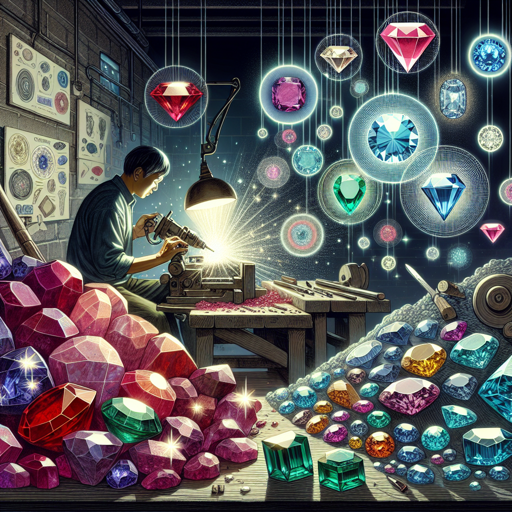
Introduction
Gemstones have captivated humans for millennia with their vibrant colors, brilliant luster, and mystical allure. But the raw stones as they emerge from the earth often bear little resemblance to the dazzling jewels that grace rings, crowns, and museums. The transformation from rough mineral to radiant gemstone is a fascinating journey—one that combines geology, artistry, and meticulous craftsmanship. This journey centers on the art of gemstone cutting, also known as lapidary.
In this article, we delve into the mesmerizing world of gemstone faceting and polishing. Whether you’re a geology enthusiast, an aspiring lapidary artist, an educator looking to enrich your lessons, or simply someone enchanted by gemstones, this in-depth guide will illuminate the techniques, history, and science behind the brilliance of cut gems.
The Evolution of Gemstone Cutting
Gem cutting is both an ancient art and a continually evolving science. Early civilizations such as the Egyptians and Greeks shaped stones by abrasion, creating beads and simple cabochons (rounded, polished stones without facets). The pursuit of brilliance—maximizing a stone’s interaction with light—ushered in the age of faceting.
Historical Milestones
- Ancient Times: Early lapidaries used sand and rudimentary tools to polish stones for decorative and ceremonial purposes.
- Middle Ages: The advent of harder abrasives like emery and diamond dust enabled more precise shaping.
- Renaissance (1400s): The first true faceted gemstones appeared in Europe. The table cut and rose cut were among the earliest.
- Modern Era: Advances in tools, optics, and mineralogy have led to sophisticated cuts like the brilliant cut, maximizing sparkle and color.
“The beauty of a gemstone lies not only in its nature but also in the hands that reveal its inner fire.”
— Anonymous Lapidary Proverb
Understanding Gem Structures
Before any cutting or polishing can take place, lapidaries must understand the internal structure of the stone. Each mineral possesses a unique crystal lattice, cleavage planes (natural break lines), hardness (measured by Mohs scale), and optical properties.
Key Mineral Properties for Cutting
| Property | Description | Impact on Cutting |
|---|---|---|
| Hardness | Resistance to scratching (Mohs scale) | Determines abrasives used |
| Cleavage | Tendency to split along planes | Risks during shaping |
| Refractive Index | Measures light bending within mineral | Affects brilliance |
| Toughness | Resistance to breaking or chipping | Influences shape choices |
| Color | Caused by trace elements or crystal defects | Guides orientation |
Understanding these properties is crucial for choosing how to orient the rough stone to maximize both durability and beauty.
The Faceting Process: Step by Step
Faceting is the process of cutting flat faces (facets) on a stone in precise geometric patterns. Each facet acts as a mirror, reflecting and refracting light to produce brilliance and fire.
1. Selecting and Evaluating Rough Gemstones
The process begins with the selection of rough material. Lapidaries evaluate:
- Clarity: Looking for inclusions (internal flaws) that might affect durability or appearance.
- Color Zoning: Positioning the stone to enhance desirable colors.
- Shape and Size: Maximizing yield while removing waste.
2. Planning the Cut
Planning is both an art and a science. Decisions must optimize:
- Yield: How much finished gemstone can be obtained from the rough.
- Brilliance: How well the finished gem will reflect light.
- Shape: Matching the rough’s natural form to classic shapes (round, oval, pear) or custom artistic designs.
3. Preforming
Preforming involves shaping the rough gem into a form close to the intended final shape using coarse abrasives. This stage removes flaws and prepares the stone for more precise work.
4. Dopping
The stone is attached to a “dop stick” with wax or adhesive. This allows for controlled handling during faceting.
5. Faceting
Using a faceting machine, the lapidary carefully grinds flat faces at precise angles:
- Pavilion: The lower part of the stone is cut first.
- Crown: The upper part (above the girdle) is cut after pavilion completion.
- Girdle: The widest part of the gem, separating pavilion from crown.
Angles are chosen based on refractive index to maximize internal reflection—critical for brilliance.
6. Polishing
After all facets are cut, each face is polished sequentially using finer abrasives and polishing compounds (such as cerium oxide or diamond paste) until a mirror-like finish is achieved.
7. Inspection and Cleaning
The finished gem is inspected for symmetry, polish quality, and alignment before being cleaned and set into jewelry or added to collections.
Common Gemstone Cuts
Gemstones can be fashioned into myriad shapes. Here’s a comparison of some classic cuts:
| Cut Name | Appearance | Best For | Key Features |
|---|---|---|---|
| Brilliant | Round with 57–58 facets | Diamonds, Garnets | Maximizes sparkle |
| Step (Emerald) | Rectangular with parallel facets | Emeralds, Aquamarines | Highlights color, minimizes waste |
| Cabochon | Smooth dome, no facets | Opals, Star Sapphires | Enhances effects like asterism |
| Princess | Square with pointed corners | Diamonds | Modern brilliance |
| Pear | Teardrop shape | Sapphires, Topaz | Elegant symmetry |
Essential Tools and Materials
Modern lapidary workshops are equipped with specialized tools designed for precision:
- Faceting Machine: Main tool for cutting facets at precise angles.
- Laps: Discs coated with diamond or other abrasives for grinding and polishing.
- Dop Sticks: Handles for holding gems during work.
- Magnification Tools: Loupes or microscopes for inspection.
- Polishing Compounds: Such as diamond paste or cerium oxide.
For educators or hobbyists starting out, basic cabochon cutting requires simpler equipment such as flat laps and hand tools.
Challenges in Gemstone Cutting
Even with modern technology, gem cutting presents unique challenges:
- Inclusions: Internal flaws can cause breakage if not carefully avoided or incorporated into the design.
- Cleavage Planes: Some gems split easily along certain planes—requiring expert handling.
- Heat Sensitivity: Some stones are sensitive to heat generated during cutting.
- Maximizing Value: Balancing size retention with ideal proportions for beauty.
The Science of Brilliance
What makes a cut gemstone sparkle? The answer lies in physics—specifically, how light interacts with the stone’s facets.
- Refraction: Light bends as it enters the stone; if cut at correct angles (critical angle), it reflects internally before exiting—this creates brilliance.
- Dispersion (“Fire”): Some stones split light into rainbow colors; perfect faceting enhances this effect.
- Symmetry: Precision in facet alignment ensures even light reflection; poor symmetry leads to dullness.
A well-cut gem can transform even modest material into a thing of mesmerizing beauty.
Innovations in Gem Cutting
Technology continues to revolutionize gemstone cutting:
- Computer-Aided Design (CAD): Allows planning of intricate shapes and cuts virtually.
- Laser Cutting: Enables precision beyond traditional mechanical tools.
- Automated Faceting Machines: Increasing accuracy and speed for commercial production.
- 3D Scanning: Helps analyze rough stones for optimal yield.
These advances allow artists to push creative boundaries while maximizing value from every carat.
Learning Gem Cutting: Education & Resources
Aspiring lapidaries have more resources than ever:
- Clubs & Societies: Organizations like The International Gem Society offer guides, forums, and certification programs.
- Workshops & Classes: Many cities host hands-on classes for beginners.
- Books & Online Tutorials: Extensive literature covers beginner to expert techniques.
- Universities & Museums: Some geology departments offer courses or exhibits on mineralogy and lapidary arts.
Whether your interest is academic or artistic, there’s a wealth of knowledge available to fuel your passion.
Tips for Educators: Bringing Lapidary Arts into the Classroom
Gemstone cutting offers engaging opportunities for earth science education:
- Demonstrations: Invite local lapidaries to demonstrate techniques.
- Virtual Tours: Many museums offer virtual tours of gem collections and workshops.
- Hands-On Projects: Simple cabochon polishing kits allow students to experience lapidary first-hand (with proper safety measures).
- Interdisciplinary Learning: Combine geology with art by discussing mineral structures alongside creative design.
Table: Quick Reference—Gem Mineral Suitability for Cutting
| Gemstone | Mohs Hardness | Cleavage | Common Cut Styles | Special Considerations |
|---|---|---|---|---|
| Diamond | 10 | Perfect | Brilliant, Princess | Very hard; cleaves easily |
| Sapphire | 9 | None | Brilliant, Cabochon | Heat sensitive |
| Emerald | 7.5–8 | Moderate | Step (Emerald) | Inclusions; brittle |
| Opal | 5.5–6.5 | None | Cabochon | Fragile; avoid heat |
| Garnet | 6.5–7.5 | None | Brilliant | Tough; wide color range |
| Topaz | 8 | Perfect | Pear, Oval | Cleaves easily |
A Glimpse Into the Future
As technology advances and artistic tastes evolve, so too does the art of gemstone cutting. New synthetic materials challenge traditional methods; ethical sourcing raises questions about sustainability; digital design opens new realms of possibility. Yet at its heart, lapidary remains a celebration of nature’s beauty—revealed through human ingenuity.
“Each gem tells two stories: one written by the earth over eons, another by the artist’s hand in hours.”
— John Sinkankas, pioneering American gemologist
Further Reading & Resources
For those eager to continue exploring:
- International Gem Society: Gem Cutting Overview
- Sinkankas, John. Gem Cutting: A Lapidary’s Manual.
- Smithsonian National Museum of Natural History Gem Gallery (virtual tour)
Conclusion
The art of gemstone cutting bridges geology and artistry—a union where science meets creative vision. Through careful study of each mineral’s properties and masterful technique, lapidaries coax hidden brilliance from humble stones. Whether you’re studying minerals academically or simply marveling at a sparkling jewel in a shop window, remember: behind every polished gem lies a story shaped by both earth and human hands.
Explore further, experiment safely if you’re inspired to try lapidary yourself, and let your appreciation for minerals deepen with each facet revealed!
For more articles on minerals, mining, gemstones, and earth sciences, stay tuned to our blog.