 Mineral Matrix: An AI Journey into Earth’s Treasures
Minerals Powering the Renewable Energy Revolution
Explore how critical minerals fuel wind, solar, and battery tech for a sustainable future.
Introduction
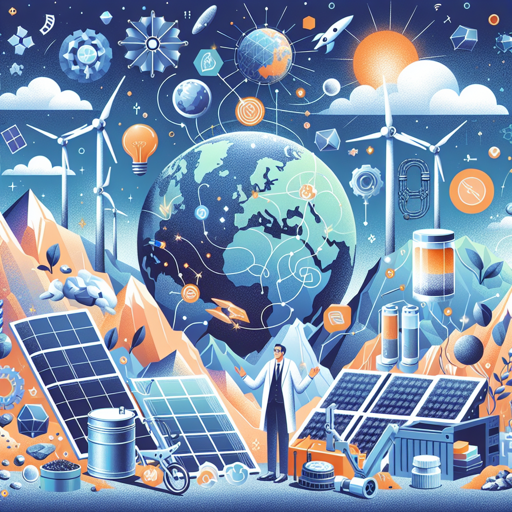
The transition to renewable energy is one of the most defining shifts of the 21st century. Wind turbines spinning across plains, solar panels gleaming on rooftops, and electric vehicles humming along highways are now common sights. But beneath this green revolution lies a lesser-known reality: minerals are the unsung heroes powering the technologies that promise a cleaner future.
From rare earth elements in wind turbines to lithium in batteries, minerals are the backbone of clean energy. Without them, the march toward sustainability would stall. For geology enthusiasts, educators, students, and anyone curious about earth sciences, understanding the role of minerals in renewable energy unveils a fascinating intersection of geology, technology, and society.
In this article, we’ll explore which minerals are essential for renewable energy technologies, how they’re sourced, and the opportunities and challenges their use presents for our planet.
The Mineral Foundations of Renewable Energy
Minerals: The Building Blocks of Clean Technology
Minerals are naturally occurring inorganic substances with distinct chemical compositions and structures. While many think of minerals as beautiful crystals or valuable ores, their industrial applications are vast and crucial. In renewable energy, minerals provide the raw materials for electrical conductivity, magnetism, corrosion resistance, and storage capabilities.
Let’s delve into three major renewable technologies—wind turbines, solar panels, and batteries—and examine their mineral requirements.
Wind Power: Harnessing the Air with Rare Earths
Wind turbines are marvels of modern engineering. Their massive blades can be taller than skyscrapers, and inside their nacelles lies an array of sophisticated machinery. At the heart of many wind turbines is a permanent magnet generator—a technology that relies heavily on rare earth elements (REEs).
Key Minerals in Wind Turbines
- Neodymium & Dysprosium: These rare earth elements are critical for making strong permanent magnets that operate efficiently even at high temperatures.
- Copper: Used extensively in wiring and generators for its excellent electrical conductivity.
- Steel (Iron Ore): The structural backbone of turbines comes from steel, which is derived from iron ore.
- Zinc: Often used as a coating to protect steel parts from corrosion.
Why Rare Earths Matter
The magnets inside wind turbines must be both powerful and durable. Neodymium-iron-boron (NdFeB) magnets offer these properties but require not only neodymium but also dysprosium to improve heat resistance. As wind turbines grow larger and more efficient, demand for these minerals increases.
Solar Power: Mining the Sun’s Energy
Solar panels capture sunlight and convert it into usable electricity through photovoltaic (PV) cells. Each PV cell is a testament to mineral ingenuity.
Key Minerals in Solar Panels
- Silicon: The primary material in most PV cells. Silicon is abundant but requires high-purity refining.
- Silver: Essential for conductive paste in solar cells; silver ensures efficient transport of electricity.
- Tellurium & Cadmium: Used in thin-film PV technologies (CdTe panels).
- Indium & Gallium: Important for copper indium gallium selenide (CIGS) panels.
- Copper: Found in wiring and module frames.
Spotlight on Silver
While silicon forms the base of most solar cells, silver’s unparalleled conductivity makes it irreplaceable for connecting cells. As solar adoption grows globally, so does the pressure on silver supplies.
Batteries: Storing Renewable Power with Critical Minerals
Energy storage is vital for balancing supply and demand in renewable grids. Rechargeable batteries—especially lithium-ion types—are central to this effort.
Key Minerals in Batteries
- Lithium: The “white gold” of modern batteries; powers everything from smartphones to electric cars and grid storage.
- Cobalt: Enhances battery stability and energy density.
- Nickel: Increases battery capacity and longevity.
- Graphite: Used as anode material in most lithium-ion batteries.
- Manganese: Improves safety and performance in certain battery chemistries.
The Demand for Lithium
Lithium extraction has skyrocketed in recent years. As nations push for electric vehicles (EVs) and large-scale storage, lithium is at the center of a new global resource race.
Comparison Table: Mineral Needs Across Technologies
Below is a comparative table highlighting key minerals used in wind turbines, solar panels, and batteries:
| Mineral | Wind Turbines | Solar Panels | Batteries |
|---|---|---|---|
| Neodymium | Permanent magnets | — | — |
| Dysprosium | Magnet heat resistance | — | — |
| Copper | Wiring/generators | Wiring/frames | Some wiring |
| Silver | — | Conductive paste | — |
| Silicon | — | Photovoltaic cells | — |
| Lithium | — | — | Electrolyte/cathode/anode |
| Cobalt | — | — | Cathode |
| Nickel | — | — | Cathode |
| Graphite | — | — | Anode |
| Manganese | — | — | Cathode |
| Iron/Steel | Structure | Module frames/supports | — |
| Tellurium | — | Thin-film PV (CdTe) | — |
| Indium/Gallium | — | Thin-film PV (CIGS) | — |
| Zinc | Corrosion protection | — | — |
Mining and Supply Chains: Challenges and Opportunities
The minerals that power renewables don’t appear out of thin air; they’re mined from Earth’s crust—sometimes from remote or geopolitically sensitive regions.
Global Supply Concentrations
A handful of countries dominate the production of critical minerals:
- China: Leads in rare earth element production (over 70% of global supply).
- Chile, Argentina, Australia: Top producers of lithium.
- Democratic Republic of Congo: Supplies more than 70% of the world’s cobalt.
- Australia, Indonesia, Russia: Major sources of nickel.
This concentration can create vulnerabilities. Disruptions due to trade disputes, political instability, or environmental concerns can ripple through global supply chains.
Environmental Impact of Mineral Extraction
Mining has its own environmental footprint—ranging from habitat disruption to water pollution. For example:
- Lithium brine extraction can deplete water resources in arid regions.
- Cobalt mining has raised concerns over ethical sourcing and human rights.
- Rare earth mining often generates toxic waste if not managed responsibly.
However, compared to fossil fuel extraction and combustion, the overall lifecycle emissions from mining for renewables are far lower. Advances in recycling and sustainable mining practices offer hope for reducing impacts further.
Quote
“The clean energy transition will be mineral intensive. Ensuring secure and sustainable supplies of critical minerals is essential for achieving climate goals.”
— International Energy Agency (IEA), The Role of Critical Minerals in Clean Energy Transitions
Innovations: Meeting Mineral Demand Sustainably
The growing demand for critical minerals is driving innovation across several fronts:
1. Mineral Recycling
Old electronics, spent batteries, and decommissioned solar panels are rich sources of reusable minerals. Developing efficient recycling methods can help close the loop—reducing reliance on new mining.
2. Alternative Materials
Researchers are investigating battery chemistries that use less cobalt or substitute abundant materials (like sodium or iron) for lithium or nickel. Perovskite solar cells—using more common elements—could reduce dependence on rare metals.
3. Responsible Mining Practices
New standards focus on minimizing environmental harm and ensuring fair labor practices. Certification schemes like IRMA (Initiative for Responsible Mining Assurance) encourage sustainable operations.
4. Geopolitical Cooperation
Diversifying supply chains through international partnerships can enhance mineral security and reduce bottlenecks.
Educational Focus: Teaching Mineral Roles in Renewables
For educators and geology students, this topic offers rich opportunities:
- Field Trips: Visiting mines or recycling facilities.
- Lab Activities: Analyzing mineral samples from renewable tech products.
- Case Studies: Exploring ethical sourcing dilemmas.
- Interdisciplinary Projects: Connecting geology with engineering and policy studies.
Understanding mineral roles highlights how earth sciences underpin technological progress—and why stewardship matters.
Future Outlook: The Road Ahead
As solar panels spread across rooftops, wind farms dot landscapes, and electric vehicles roll off assembly lines, the demand for critical minerals will only intensify. According to the International Energy Agency (IEA), achieving global climate goals could increase mineral demand by up to six times by 2040.
Investment in exploration—both terrestrial and potentially marine—could open new sources. Yet responsible management is paramount to ensure that today’s green revolution does not create tomorrow’s environmental or social crises.
Conclusion
Minerals are the hidden drivers behind the transformation toward renewable energy. From neodymium in wind turbines to lithium in batteries and silver in solar panels, these earthly resources make clean technology possible.
For geology enthusiasts, educators, students, and earth science lovers, exploring the world of critical minerals reveals both challenges and possibilities. The path to a sustainable future depends not only on harnessing wind or sunlight but also on understanding—and responsibly managing—the mineral wealth beneath our feet.
As we power up for a cleaner tomorrow, let’s remember that every spark of renewable energy begins with a mineral story millions of years in the making.
External Reference
For more in-depth analysis on this topic, visit the International Energy Agency’s report on critical minerals.