 Mineral Matrix: An AI Journey into Earth’s Treasures
Pioneers of Mineralogy Shaping Earth Science
Discover the scientists who revolutionized our understanding of minerals and built the foundation of modern mineralogy.
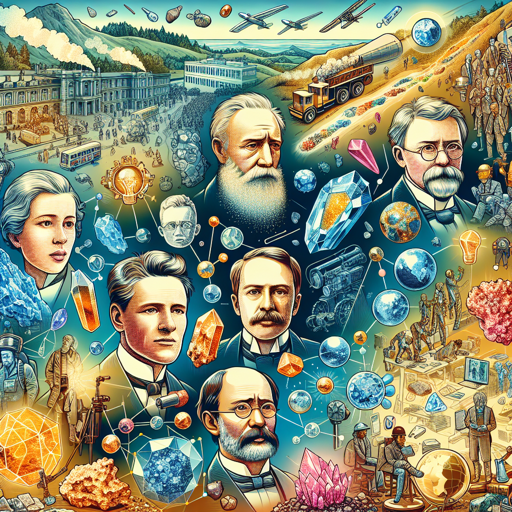
Pioneers of Mineralogy Through Time
Introduction
Minerals are the building blocks of our planet. From the dazzling colors of gemstones to the raw materials driving technology and civilization, minerals shape the world around us. But how did we come to understand their secrets—their compositions, structures, and origins? This journey was made possible by the curiosity, determination, and brilliance of countless scientists across centuries.
Today, we delve into the stories of the most influential pioneers of mineralogy—people whose passion for Earth’s treasures transformed not only geology, but also technology, chemistry, and our appreciation of natural beauty. Whether you’re a seasoned geologist, an educator seeking inspiration for your students, or a curious enthusiast, these stories reveal the human side of science and the relentless quest to decipher the planet beneath our feet.
Tracing the Roots: Early Curiosity and Classification
The Dawn of Mineral Study
Long before mineralogy became a formal science, ancient civilizations marveled at crystals and gemstones. The Greeks named many minerals—calling quartz “krystallos” and linking their observations to mythology. Yet true scientific exploration was limited by a lack of analytical tools.
Theophrastus (c. 371–287 BCE): The Father of Mineral Description
One of the earliest systematic works was On Stones by Theophrastus, a disciple of Aristotle. He described more than 60 “stones,” classifying them by properties such as hardness—an early attempt at mineral classification.
“Theophrastus’ treatise marks the transition from myth to method in mineral study.” — Encyclopedia Britannica
Pliny the Elder (23–79 CE): Cataloguer of Natural Wonders
Pliny’s Natural History provided one of antiquity’s most comprehensive catalogs of minerals and gems. He linked minerals to their uses in art, medicine, and technology, reflecting the interconnectedness of science and society.
Systematic Science Emerges: Foundations of Modern Mineralogy
The Renaissance saw a surge in natural sciences as knowledge spread through printing and exploration expanded horizons.
Georgius Agricola (1494–1555): Father of Mineralogy

Agricola’s De Re Metallica (1556) is a monumental work on mining and minerals. He systematically described ore formation, mining techniques, and mineral identification—establishing mineralogy as a true science.
Key Contributions:
- Classified minerals by physical properties (color, luster, hardness)
- Differentiated minerals from rocks
- Laid groundwork for mining engineering
Axel Fredrik Cronstedt (1722–1765): Discovery of Nickel
Swedish chemist Cronstedt’s identification of nickel as a new element in 1751 is legendary. He used flame tests to differentiate minerals—a precursor to instrumental analysis.
Legacy:
- Invented mineral classification based on chemical composition
- Advanced the use of scientific methods in mineralogy
Breakthroughs in Crystallography and Chemistry
The 18th and 19th centuries brought tools and theories that revolutionized our understanding of crystal structure and mineral chemistry.
René Just Haüy (1743–1822): The Father of Modern Crystallography

A broken calcite crystal inspired Haüy to propose that crystals are built from repeating geometric units. This insight birthed crystallography—the study of crystal forms—and revealed the ordered nature of minerals.
Haüy’s Highlights:
- Developed mathematical laws for crystal symmetry
- Introduced the concept of unit cells
- Proved that external crystal shape reflects internal structure
“Everything in nature is ordered according to certain laws.”
— René Just Haüy
Jöns Jacob Berzelius (1779–1848): Chemical Classification Pioneer
A Swedish master of analytical chemistry, Berzelius standardized chemical symbols and developed mineral classification by composition rather than just appearance.
Major Achievements:
- Introduced modern chemical notation (e.g., H₂O for water)
- Classified silicates and other mineral groups
- Discovered several elements (cerium, selenium, thorium)
Unlocking Atomic Secrets: X-rays and Mineral Structure
William Henry Bragg (1862–1942) & William Lawrence Bragg (1890–1971): X-ray Crystallographers
This father-son duo transformed mineralogy with X-ray crystallography. By analyzing how X-rays diffract through crystal lattices, they mapped atomic arrangements—paving the way for modern mineral science.
Their Revolution:
- Determined first atomic structures (e.g., sodium chloride)
- Enabled precise identification of complex minerals
- Awarded Nobel Prize in Physics (1915)
Victor Goldschmidt (1888–1947): Geochemistry Visionary
Goldschmidt’s pioneering work unified mineralogy with chemistry and geology. His “Goldschmidt Rules” explain how elements distribute within minerals—crucial for understanding ore deposits and planetary differentiation.
Impact:
- Developed geochemical classification schemes
- Explained elemental substitution in crystals
- Laid foundations for modern geochemistry
Table: Comparing Pioneers and Their Contributions
| Name | Era | Key Contributions | Lasting Impact |
|---|---|---|---|
| Theophrastus | 4th c. BCE | Early mineral descriptions | Systematic observation begins |
| Pliny the Elder | 1st c. CE | Cataloged minerals/gems; practical uses | Linked science & society |
| Georgius Agricola | 16th c. | Systematic classification; mining engineering | Mineralogy as science |
| Axel Fredrik Cronstedt | 18th c. | Chemical analysis; discovery of nickel | Chemistry in mineral ID |
| René Just Haüy | 18th–19th c. | Crystallography; unit cell theory | Modern crystal science |
| Jöns Jacob Berzelius | 19th c. | Chemical notation; elemental classification | Chemical basis for mineral groups |
| W.H. & W.L. Bragg | 20th c. | X-ray crystallography; atomic structure mapping | Structural mineral analysis |
| Victor Goldschmidt | 20th c. | Geochemistry; elemental distribution | Understanding ore genesis & planets |
Beyond Europe: Global Perspectives in Mineralogical Discovery
While many early luminaries hailed from Europe, contributions have come from around the world:
Yoshiaki Tsuchiya (1882–1971): Japanese Mineralogical Pioneer
Tsuchiya advanced crystallography in Japan, cataloging hundreds of native minerals and mentoring generations of Asian mineralogists.
Female Trailblazers: Kathleen Lonsdale (1903–1971)
Lonsdale broke barriers as one of the first women admitted to the Royal Society. Her X-ray studies on diamond established that even complex crystals could be mapped atom by atom.
African and Indigenous Knowledge
Traditional societies often possessed intimate knowledge of local minerals—vital for tool making, art, or spiritual practices—though these are less documented in Western science.
How These Pioneers Shaped Modern Science and Industry
The insights of mineralogical pioneers ripple far beyond academia:
- Mining Industry: Improved ore identification increases efficiency and safety.
- Gemology: Scientific analysis assures authenticity and enhances value assessment.
- Materials Science: Understanding crystal structure leads to innovations from semiconductors to superconductors.
- Earth Sciences: Geochemical models aid our comprehension of planetary formation.
“The study of minerals is not simply an academic pursuit—it is a bridge between nature’s mysteries and human progress.”
Continuing the Legacy: New Frontiers in Mineralogy
Modern mineralogists stand on the shoulders of these titans while forging new paths:
- Electron Microscopy & Spectroscopy: Reveal structures at atomic scales.
- Computational Mineralogy: Simulates crystal growth and properties.
- Planetary Mineralogy: Analyzes extraterrestrial samples from Mars, asteroids, and beyond.
- Environmental Geology: Tackles pollution, resource management, and sustainability.
For a deeper dive into the history and techniques shaping contemporary mineralogy, explore this comprehensive resource from the Mineralogical Society.
Conclusion
The story of mineralogy is a saga of human curiosity—a blend of careful observation, inspired hypothesis, daring experimentation, and tireless refinement. From Theophrastus’ ancient treatise to cutting-edge X-ray crystallography, each generation has unlocked another layer of Earth’s hidden order.
As we admire a sparkling gemstone or investigate an ore deposit’s promise, let us remember the scientists whose vision crafted our understanding—and whose legacy empowers us to keep exploring today’s most urgent scientific challenges.
Whether you’re teaching students about crystal symmetry or simply marveling at a quartz cluster on your desk, you are partaking in a tradition as old as civilization itself—a tradition that continues to shape our relationship with the Earth beneath our feet.
“In wisdom gathered over time I have found that every experience is a form of exploration.”
— Ansel Adams