 Mineral Matrix: An AI Journey into Earth’s Treasures
Minerals That Glow Under UV Light
Discover the science and beauty behind fluorescent minerals
Introduction
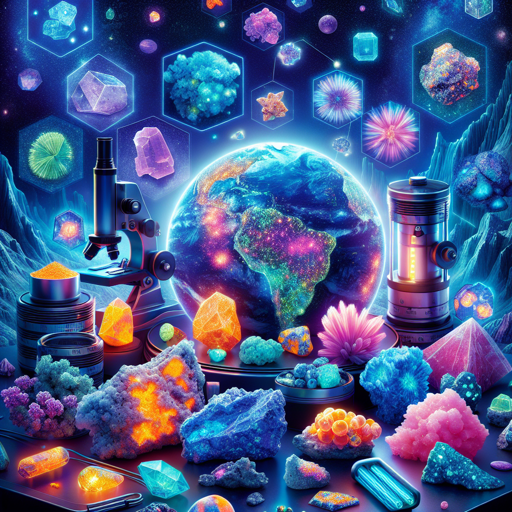
Have you ever wandered through a mineral exhibit and noticed a darkened room where rocks glow in brilliant neon hues? This magical spectacle is more than a trick of the light—it’s the natural phenomenon of fluorescence. Certain minerals, when exposed to ultraviolet (UV) light, emit vivid colors that are invisible under normal lighting conditions. But what causes this radiant transformation? Why do only some minerals fluoresce? And which minerals put on the most dazzling displays?
Join us as we illuminate the fascinating world of fluorescent minerals—a realm where science meets wonder, and geology comes alive in glowing technicolor.
The Science Behind Fluorescence
What Is Fluorescence?
Fluorescence is the emission of visible light by a substance that has absorbed light or other electromagnetic radiation. In minerals, this usually happens when they are exposed to ultraviolet (UV) light—a form of energy invisible to our eyes but packed with enough power to excite certain atomic structures.
When UV photons strike a mineral, they can transfer energy to electrons within the atoms or molecules. These electrons jump to a higher energy state. When they return to their normal state, they release that energy as visible light. The result? A radiant glow that can range from cool blues and greens to fiery reds and oranges.
Why Do Only Some Minerals Fluoresce?
Not all minerals fluoresce under UV light. For fluorescence to occur, a mineral’s crystal structure must contain activator elements or impurities—such as manganese, lead, uranium, or rare earth elements—that can absorb UV energy and re-emit it as visible light. Sometimes, even trace amounts of these activators are enough to produce a dazzling glow.
Conversely, some elements called quenchers can suppress fluorescence by absorbing the energy without re-emitting visible light. The presence or absence of these activators and quenchers—along with the mineral’s unique structure—determines whether it will fluoresce.
Types of Ultraviolet Light Used in Mineralogy
UV light is categorized by its wavelength:
- Longwave UV (UVA): 320–400 nm; common in commercial “black lights.”
- Shortwave UV (UVC): 100–280 nm; more energetic and often used in mineral displays.
- Midwave UV (UVB): 280–320 nm; less commonly used but produces unique effects in some minerals.
Different minerals may react more strongly to specific UV wavelengths, glowing more intensely or in different colors under longwave versus shortwave UV.
Popular Fluorescent Minerals
Some minerals are famous for their fluorescent properties, making them favorites among collectors and educators. Here’s a table highlighting several of the most striking examples:
| Mineral Name | Typical Fluorescent Color(s) | Common Activator(s) | Notable Locations |
|---|---|---|---|
| Fluorite | Blue, purple, yellow | Europium, yttrium | England, USA, China |
| Willemite | Bright green | Manganese | Franklin & Sterling Hill, NJ, USA |
| Calcite | Red, orange, pink | Manganese | Mexico, USA |
| Scheelite | Blue-white | Tungsten | China, USA |
| Hackmanite | Pink to violet (tenebrescence) | Sulfur | Afghanistan, Canada |
| Opal | Green | Uranium | Australia, USA |
| Scapolite | Yellow, orange | Unknown | Tanzania, Canada |
| Sodalite | Orange, yellow | Sulfur | Greenland, Canada |
Case Study: The Franklin and Sterling Hill Mines
Perhaps the most iconic site for fluorescent minerals is in northern New Jersey: the Franklin and Sterling Hill mines. These legendary zinc ore deposits are renowned for their diversity of glowing minerals—over 90 distinct species have been documented as fluorescent!
Here, bold green willemite and fiery red calcite create mesmerizing displays under shortwave UV light. The unique geological history of the area led to an extraordinary concentration of activator elements, making these mines world-famous among collectors and scientists.
“The Franklin-Sterling Hill area is universally recognized as the fluorescent mineral capital of the world.” — The Franklin Mineral Museum
How to View Fluorescent Minerals at Home
You don’t need a museum to enjoy these luminous wonders—many collectors build their own displays at home!
What You Need
- UV Lamp: For best results, use a shortwave and/or longwave UV lamp designed for mineral displays. Always avoid direct exposure to eyes or skin.
- Dark Room: A completely dark environment enhances the effect.
- Samples: Purchase or collect known fluorescent minerals from reputable sources.
Safety First
- Avoid looking directly at UV sources.
- Wear protective eyewear if using shortwave lamps.
- Keep lamps away from children.
Beyond Glow: Other Luminescent Phenomena
While fluorescence is the most famous type of mineral luminescence, others exist:
- Phosphorescence: Minerals continue to glow after the UV source is removed (like “glow-in-the-dark” toys).
- Triboluminescence: Light emission caused by scratching or crushing a mineral.
- Thermoluminescence: Emission triggered by heat.
Some minerals exhibit more than one type of luminescence!
Table: Quick Guide to Fluorescent Minerals
| Property | Fluorescence | Phosphorescence |
|---|---|---|
| Trigger | UV Light | UV Light (then off) |
| Duration | Only when lit | Continues after lamp |
| Common Minerals | Willemite, Calcite | Esperite, some Calcite |
| Use in Identification | Yes | Sometimes |
Why Do Fluorescent Minerals Matter?
Scientific Importance
Fluorescent properties can help geologists:
- Identify minerals in the field or lab.
- Reveal hidden zoning or patterns in crystals.
- Track ore deposits (certain ores fluoresce predictably).
Practical Applications
Fluorescence isn’t just for show; it’s used in:
- Mining (ore sorting)
- Forensic science
- Gemstone authentication
- Education and public outreach
Artistic and Cultural Significance
The aesthetic appeal of glowing minerals has inspired jewelry designers, artists, and museum curators worldwide.
Famous Fluorescent Gemstones
While many fluorescent minerals are not gem-quality, some gemstones are famous for their glow:
- Ruby: Often glows bright red due to chromium.
- Diamond: May fluoresce blue under longwave UV.
- Sapphire: Some specimens show orange or red fluorescence.
- Opal: Certain varieties emit green fluorescence.
These properties can aid in gemstone identification and add unique allure for collectors.
Collecting Tips for Beginners
- Start Small: Purchase a few known specimens (like calcite or fluorite).
- Invest in a Quality Lamp: A shortwave/longwave combo lamp gives maximum versatility.
- Label Everything: Keep track of your specimens’ localities and properties.
- Join Clubs or Forums: The community is welcoming and knowledgeable!
- Respect Regulations: If field collecting, always get permission and follow safety guidelines.
Inspiring Quote
“In every glowing rock lies a hidden story—one that begins deep within Earth’s embrace and ends with a flash of radiant color.” — Anonymous geologist
Learn More
For those who wish to dive deeper into this subject or view spectacular photos of fluorescent minerals, check out:
Conclusion
Fluorescent minerals remind us that nature is full of surprises—often hidden just beyond the spectrum of ordinary sight. These glowing treasures bridge the worlds of art and science, captivating anyone with an eye for beauty or curiosity about the Earth’s inner workings.
Whether you’re a seasoned geologist or a curious newcomer, exploring the world of fluorescent minerals is sure to ignite your imagination—and maybe even light up your next adventure. So grab a UV lamp and discover what hidden colors are waiting in your own collection!
References: