 Mineral Matrix: An AI Journey into Earth’s Treasures
The Evolution of Mining Methods Through History
Explore how mining techniques advanced from ancient hand tools to modern automation.
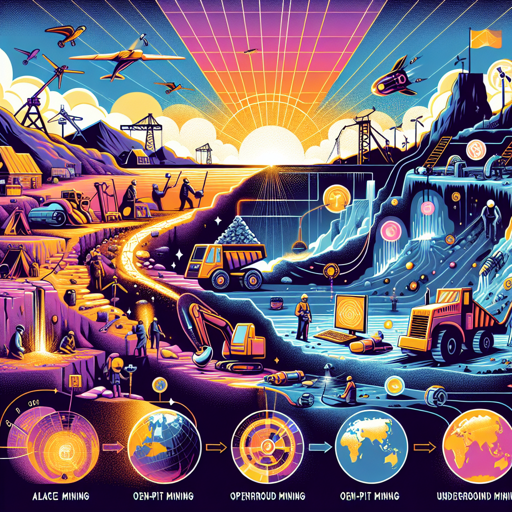
Introduction
Throughout human history, the quest for minerals and metals has shaped civilizations, driven technological innovation, and altered landscapes. Mining, at its core, is as ancient as society itself. From the first stone tools chipped from river pebbles to the ultra-deep mines that now burrow kilometers beneath the Earth’s surface, mining methods have evolved in fascinating ways.
The journey of mining is not just a tale of picks and shovels; it’s a mirror reflecting humanity’s relationship with the Earth and its resources. This article traces the remarkable evolution of mining techniques, examining how necessity, ingenuity, and technology have transformed the way we extract the building blocks of our world.
“Mining is as old as civilization itself, and its story is the story of human progress.”
— Dr. John R. Naylor, The History of Mining
Ancient Beginnings: The Dawn of Mining
Mining traces its roots back over 40,000 years. Archaeological evidence shows that early humans extracted ochre for pigments and flint for tools as far back as the Paleolithic era. The oldest known mine, the Ngwenya Mine in Swaziland, dates to around 43,000 years ago and was used for hematite extraction.
Early Techniques
Surface Collection
Early miners began with surface collection—gathering exposed minerals and stones from the ground or riverbeds. This method required no tools beyond human hands and simple baskets.
Fire-Setting
By the Neolithic period (about 12,000 years ago), miners had developed fire-setting. This involved building a fire against rock faces to heat them, then rapidly cooling the rock with water, causing it to crack. This technique allowed extraction from harder rock types.
Primitive Tools
Stone hammers, antler picks, bone chisels, and wooden wedges were used to exploit shallow ores. These tools left characteristic marks still visible in ancient mines like those at Grimes Graves (UK) and Rudna Glava (Serbia).
The Bronze and Iron Ages: Metallurgy Revolutionizes Mining
The discovery of smelting copper and tin to make bronze around 5,000 years ago sparked a revolution. Demand for metal ores soared, driving mining deeper below the surface.
Innovations in Mining Methods
| Era | Key Tool/Method | Impact on Mining Depth | Example Site |
|---|---|---|---|
| Stone Age | Stone hammers | Surface & shallow | Grimes Graves (UK) |
| Bronze Age | Bronze picks | Deeper tunnels | Timna Valley (Israel) |
| Iron Age | Iron chisels/axes | Greater depths | Rio Tinto (Spain) |
Bronze and iron tools enabled miners to penetrate harder rocks and dig more extensive underground workings. The ancient Egyptians mined gold using fire-setting and bronze tools deep into desert mountains. Meanwhile, the Romans advanced mining on an industrial scale.
Roman Innovations: Engineering Meets Mining
Roman civilization brought organization and engineering genius to mining operations.
Roman Techniques
- Quarrying: Large-scale open pit mining for building stones and metals.
- Adits & Shafts: Horizontal tunnels (adits) and vertical shafts enabled access to deep ore bodies.
- Water Power: The Romans harnessed water wheels to power bellows for smelting and drainage pumps to remove water from mines.
- Hydraulic Mining: At Las Médulas (Spain), Romans used aqueducts and water channels to erode gold-bearing hillsides—a precursor to later placer mining.
Roman mines were so advanced that some techniques were not surpassed until the Industrial Revolution.
The Middle Ages: Guilds and Gunpowder
Following Rome’s decline, Europe’s mining methods stagnated until the late Middle Ages.
Medieval Advances
- Mining Guilds: These organizations standardized techniques and safety practices.
- Timbering: Wooden supports (timber sets) were widely used to prevent tunnel collapse.
- Ventilation: Shafts and bellows improved air quality underground.
- Gunpowder: First used in 17th-century Germany, gunpowder revolutionized rock breaking, making deeper mining possible.
The Industrial Revolution: Mechanization Emerges
The 18th and 19th centuries saw explosive growth in mining thanks to steam power and mechanization.
Key Developments
| Innovation | Impact |
|---|---|
| Steam engines | Pumped water from deeper shafts |
| Mechanical drills | Increased drilling speed & efficiency |
| Rail transport | Moved ore efficiently |
| Explosives | Enabled mass rock breaking |
Mechanization made mines larger, deeper, and more productive. The coalfields of Britain and the gold rushes of California and Australia were only possible with these advances.
Modern Mining: Precision, Safety, Sustainability
Today’s mining industry is a fusion of high-tech engineering, environmental science, and automation.
Current Methods
Surface Mining
- Open-Pit Mining: Massive earth-moving equipment extracts ore from giant pits—used for copper, gold, iron.
- Strip Mining: Removes surface layers for coal or phosphate.
- Mountaintop Removal: Used in some coal regions (controversial due to environmental impact).
Underground Mining
- Room-and-Pillar: Leaves pillars of ore for support—common for coal.
- Longwall Mining: Automated shearing machines remove entire seams.
- Block Caving: Allows large sections of ore to collapse under gravity.
Placer & Solution Mining
- Placer Mining: Uses water to extract gold or gems from river sediments.
- In-Situ Leaching: Chemicals dissolve metals underground (e.g., uranium), minimizing surface disruption.
Technology Integration
Modern mines deploy:
- Remote-controlled machinery
- Drones for surveying
- Geographic information systems (GIS)
- Real-time environmental monitoring
Automation increases safety by keeping people out of dangerous environments.
Key Comparisons: Then vs. Now
| Aspect | Ancient Mining | Modern Mining |
|---|---|---|
| Power Source | Human/animal | Electric/diesel/renewable energy |
| Tools | Stone/bronze/iron | Advanced machinery & robotics |
| Depth | Shallow (<30m) | Ultra-deep (>4,000m in gold/platinum mines) |
| Environmental Care | Minimal | Regulated restoration & monitoring |
| Worker Safety | Poor | PPE, automation, strict safety standards |
| Extraction Speed | Slow | Rapid & continuous |
Environmental Considerations: Lessons Learned
As mining methods evolved, so too did awareness of their environmental impact. Ancient workings left scars but were small in scale. Industrial-era mining caused extensive deforestation, pollution, and land degradation.
Modern regulations require environmental assessments, reclamation plans, and pollution controls. Today’s focus is on “sustainable mining” — balancing resource needs with ecosystem protection.
For example:
- Mines now must restore landscapes after closure.
- Water treatment systems prevent toxic runoff.
- In some cases, abandoned mines are repurposed for tourism or energy storage.
The Future: Digital Transformation and Beyond
Where is mining headed? Futuristic visions include:
- Autonomous Mines: Entirely self-operating equipment guided by AI.
- Space Mining: Extracting rare minerals from asteroids or the Moon.
- Bio-mining: Using bacteria to leach metals from ores.
- Zero-Waste Operations: Circular economy models to minimize waste.
Many companies are already piloting autonomous haulage and drilling systems. Deep-sea mining for nodules is under debate due to ecological concerns.
External Reference
For a deeper dive into the history and future of mining technology, see Society for Mining, Metallurgy & Exploration - A Brief History of Mining.
Conclusion
From humble beginnings with stone hammers to today’s high-tech autonomous drills, the evolution of mining methods is a testament to human innovation and adaptability. Each era’s methods reflect its technology, priorities, and understanding of the Earth. As we move into an age of digital transformation and sustainability challenges, mining will continue to evolve—shaping both our landscapes and our future.
Whether you’re a geology enthusiast, educator, student, or simply fascinated by Earth’s treasures, understanding this journey helps appreciate not only how we extract minerals—but how we’ve grown alongside them. The story of mining is far from over; its next chapter may be written in data streams as much as in stone.