 Mineral Matrix: An AI Journey into Earth’s Treasures
Cleavage Fracture and Luster in Minerals Explained
Learn how cleavage fracture and luster help identify minerals easily.
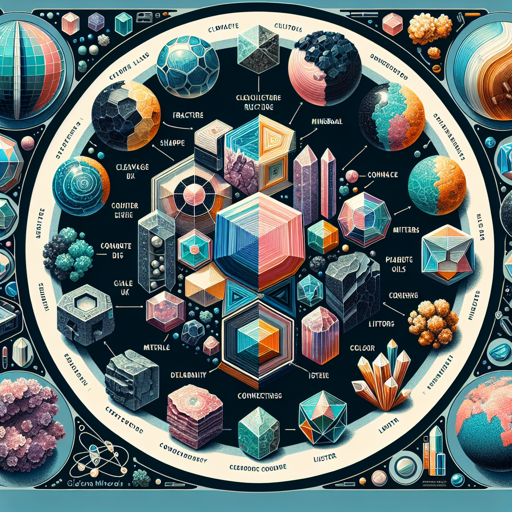
Cleavage Fracture and Luster in Minerals Explained
Introduction
From the dazzling sparkle of gemstones to the rough edges of mining spoils, minerals intrigue us with their diverse forms and properties. If you’ve ever wondered how geologists can identify a mineral at a glance or with a quick scratch test, you’re not alone! Mineral identification is a fascinating blend of art and science, relying on observable features like color, hardness, and, importantly, cleavage, fracture, and luster.
These three properties—cleavage, fracture, and luster—are not just jargon; they are practical tools that reveal the story behind every mineral specimen. Whether you’re a geology enthusiast, an educator introducing students to earth science, or a collector eager to know what’s in your hand lens, understanding these concepts will deepen your appreciation and skill in mineral identification.
In this article, we’ll explore what cleavage, fracture, and luster mean, why they matter, and how you can use them to confidently identify minerals. Let’s unlock the secrets hidden inside every rock!
What Is Cleavage? The Art of Splitting Along Planes
Definition
Cleavage refers to a mineral’s tendency to break along flat, parallel surfaces. These surfaces are planes of weakness within the crystal structure where atomic bonds are weaker. When a mineral with good cleavage is struck or broken, it splits smoothly along these planes.
Why Does Cleavage Occur?
Minerals are made up of atoms arranged in repeating patterns called crystal lattices. Sometimes, the bonds holding these atoms together are not equally strong in all directions. Where the bonds are weaker, the mineral is more likely to break. Imagine snapping a KitKat bar along its segments—cleavage works in a similar way!
Types of Cleavage
Cleavage is described by:
- Number of Directions: How many sets of cleavage planes exist (e.g., one, two, three).
- Angle Between Planes: Are the planes at right angles (90°), oblique angles, etc.?
- Quality: How easily and cleanly does the mineral split? (Perfect, good, fair, poor.)
Examples
| Mineral | Cleavage Directions | Angle | Cleavage Quality | Description |
|---|---|---|---|---|
| Mica | 1 | - | Perfect | Sheets peel off like paper |
| Halite | 3 | 90° | Perfect | Breaks into cubes (like table salt) |
| Calcite | 3 | ~75°/105° | Perfect | Breaks into rhombohedrons |
| Feldspar | 2 | 90° | Good | Blocky fragments |
| Galena | 3 | 90° | Perfect | Cubic cleavage |
How Geologists Use Cleavage
Observing cleavage helps narrow down mineral possibilities quickly. For example, if you see perfect flat sheets that peel away easily, you’re likely looking at mica. If you spot blocky breaks at right angles, feldspar or halite might be the culprit.
Fracture: When Cleavage Fails
Definition
Fracture describes how a mineral breaks when it does not follow any natural planes of weakness. Instead of splitting smoothly, the break is irregular or curved.
Types of Fracture
- Conchoidal: Smooth, curved surfaces—think of broken glass or quartz.
- Uneven/Irregular: Rough and jagged with no set pattern.
- Fibrous/Splintery: Breaks into splinters or fibers (e.g., asbestos).
- Hackly: Jagged edges like torn metal (common in native copper).
- Earthy: Powdery or crumbly (e.g., limonite).
Examples
| Mineral | Typical Fracture | Visual Description |
|---|---|---|
| Quartz | Conchoidal | Smooth, shell-like curves |
| Obsidian | Conchoidal | Glassy and sharp-edged |
| Limonite | Earthy | Crumbly and dull |
| Native Copper | Hackly | Torn metal appearance |
Why Is Fracture Important?
Some minerals lack cleavage altogether or have such poor cleavage that fracture is the main way they break. Noticing conchoidal fracture is a quick clue for quartz or obsidian. Hackly fracture points to native metals.
Luster: The Shine That Tells a Story
Definition
Luster describes how light reflects from a mineral’s surface. Is it shiny like metal? Glassy? Dull? Luster is one of the first things you notice when examining a mineral and can be quite diagnostic.
Main Types of Luster
Luster is broadly divided into two categories:
- Metallic: Looks like polished metal (e.g., pyrite, galena).
-
Non-metallic: Everything else! Includes subtypes:
- Vitreous: Glass-like shine (e.g., quartz)
- Pearly: Like pearl (e.g., talc)
- Silky: Like silk threads (e.g., gypsum fibers)
- Resinous: Like resin or plastic (e.g., sphalerite)
- Adamantine: Diamond-like brilliance (e.g., diamond)
- Dull/Earthy: No shine at all (e.g., kaolinite)
Luster Comparison Table
| Luster Type | Description | Example Minerals |
|---|---|---|
| Metallic | Shiny like metal | Pyrite, Galena |
| Vitreous | Glassy | Quartz |
| Pearly | Soft shine | Talc |
| Silky | Fibrous sheen | Gypsum (fibrous) |
| Resinous | Plastic-like | Sphalerite |
| Adamantine | Brilliant sparkle | Diamond |
| Earthy/Dull | No shine | Limonite |
How to Test Luster
Look at the mineral in good light. Does it reflect light like a coin (metallic)? Or does it resemble glass or plastic? Sometimes streaking the mineral or tilting it helps reveal the luster more clearly.
Putting It All Together: Cleavage vs. Fracture vs. Luster
Let’s compare these three key properties side by side:
| Property | What It Tells You | Key Clues | Examples |
|---|---|---|---|
| Cleavage | Weakness in crystal structure; breaks along flat planes | Smooth, flat surfaces; repeated patterns | Mica (sheets), Halite (cubes), Feldspar (blocks) |
| Fracture | No planes of weakness; breaks irregularly | Curved, jagged, uneven breaks | Quartz (conchoidal), Obsidian (conchoidal), Copper (hackly) |
| Luster | Way light reflects off surface | Metallic shine? Glassy? Dull? | Pyrite (metallic), Quartz (vitreous), Talc (pearly) |
How These Properties Aid Mineral Identification
When you pick up an unknown mineral specimen, here’s an example workflow:
- Examine Luster: Metallic or non-metallic?
- Look for Cleavage: Are there repeated flat surfaces or obvious planes?
- Check Fracture: If no cleavage, look for irregular or conchoidal breaks.
- Cross-reference With Other Properties: Use color, hardness, streak for confirmation.
These three properties alone can help you positively identify many common minerals!
A Geologist’s Perspective
“The beauty of minerals does not just lie in their color or form but in the stories their fractures and lustres tell about their atomic dance.”
— Dr. Rachel Carter, Mineralogist
Visual Table: Common Minerals by Cleavage, Fracture, and Luster
| Mineral | Cleavage | Fracture | Luster |
|---|---|---|---|
| Mica | Perfect, 1 dir | N/A | Pearly |
| Quartz | None | Conchoidal | Vitreous |
| Galena | Perfect, 3 dir | Subconchoidal | Metallic |
| Feldspar | Good, 2 dir | Uneven | Vitreous |
| Pyrite | Poor/None | Uneven | Metallic |
| Calcite | Perfect, 3 dir | Conchoidal | Vitreous |
| Gypsum | Perfect/fair | Splintery | Silky/Pearly |
| Diamond | Perfect | Conchoidal | Adamantine |
Tips for Observing Cleavage, Fracture, and Luster
- Use good lighting: Natural daylight is best for assessing luster.
- Use a hand lens: Magnify small cleavage planes or surface details.
- Break a small fragment if allowed: Helps reveal true cleavage/fracture.
- Compare with known samples: Practice makes perfect!
Why These Properties Matter Beyond Identification
Cleavage and fracture aren’t just academic—they have real-world implications:
- Mining: Minerals with perfect cleavage may break during extraction; others with conchoidal fracture make sharp tools.
- Gemstones: Cleavage affects cutting and shaping gems; diamonds have perfect octahedral cleavage requiring expert handling.
- Industrial Use: Mica’s sheet cleavage is valuable for electrical insulators; halite’s cubic cleavage aids salt production.
Understanding these properties helps geologists make decisions about resource extraction and use.
Further Reading
Want to dive deeper? The Mineralogy Database offers extensive details and photos for thousands of minerals.
Conclusion
Cleavage, fracture, and luster are more than just terms in a geology textbook—they are keys to unlocking the secrets of Earth’s hidden treasures. By learning to recognize these features with your own eyes and hands, you join a long tradition of earth scientists who read the stories written in stone.
Whether you’re exploring outcrops in the field or examining specimens at home or in the classroom, these three properties will guide you toward accurate identification and a deeper appreciation for the wonders beneath our feet.
So next time you hold a mineral sample—look for its shine, check how it breaks, and see if planes of weakness reveal themselves. The world of minerals is waiting for your curiosity!
Explore more about minerals at Mindat.org, the world’s largest mineral database and reference site.