 Mineral Matrix: An AI Journey into Earth’s Treasures
Mineral Identification Made Easy at Home
Simple at-home and outdoor techniques to identify common minerals with confidence and curiosity.
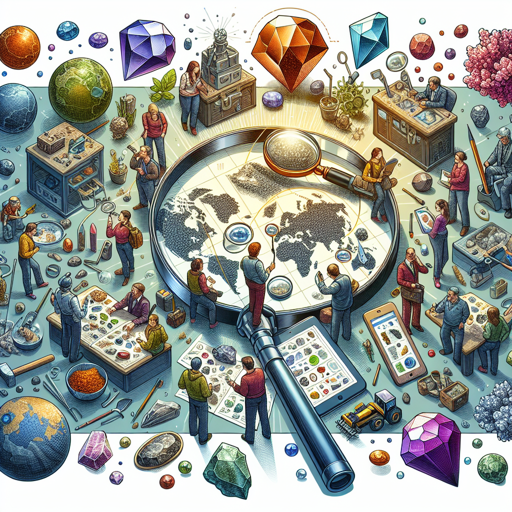
Mineral Identification Made Easy at Home
Minerals are the building blocks of our planet—sparkling crystals tucked inside rocks, hidden treasures beneath our feet. Whether you’re a geology student, an avid rockhound, or simply fascinated by the wonders of Earth, learning to identify minerals is both rewarding and surprisingly accessible. You don’t need a laboratory or fancy equipment—just curiosity, observation skills, and a few simple tools. In this guide, we’ll show you how to identify common minerals at home or outdoors, using practical techniques that anyone can master.
Why Identify Minerals?
Minerals are more than just pretty stones; they’re key to understanding the world around us. Each mineral tells a story about Earth’s formation, history, and processes. For educators, teaching mineral identification brings science to life. For collectors and enthusiasts, it sparks a lifelong passion. And for those in mining or earth sciences, it’s essential for exploration and resource management.
“In every walk with nature one receives far more than he seeks.”
— John Muir
The Foundations of Mineral Identification
Before diving into techniques, it’s helpful to understand what makes a mineral unique:
- Naturally occurring: Formed by natural processes.
- Inorganic: Not produced by living organisms.
- Solid: Maintains a definite shape and volume.
- Definite chemical composition: Has a specific formula (e.g., Quartz is SiO₂).
- Crystalline structure: Atoms arranged in orderly patterns.
These characteristics help distinguish minerals from rocks (which are mixtures of minerals) and other materials.
The Essential Mineral ID Kit
You don’t need expensive tools to get started. A basic identification kit can be assembled from household items:
| Tool | Purpose | Common Substitutes |
|---|---|---|
| Streak plate | Test mineral color in powdered form | Unglazed porcelain tile |
| Magnet | Check for magnetism | Fridge magnet |
| Glass plate | Test hardness (Mohs scale ~5.5) | Old window glass |
| Steel nail | Test hardness (Mohs scale ~6.5) | Pocketknife |
| Copper coin | Test hardness (Mohs scale ~3.0) | Penny or copper strip |
| Hand lens (10x) | Magnify crystal structure or features | Magnifying glass |
| Vinegar or acid | Test for carbonate reaction | Household vinegar |
With these tools, you’re equipped for most field or home mineral tests.
Step-by-Step Mineral Identification
Successful mineral identification is a process of observation and elimination. Here’s how to break it down:
1. Observe Physical Properties
Color
Color is the first thing people notice, but it can be misleading. Many minerals come in several colors due to impurities.
Tip: Use color as a clue, but never the sole identifier.
Streak
The streak is the color of a mineral’s powdered form. Rub your specimen on an unglazed porcelain tile (streak plate). The streak can reveal the true color, especially for metallic minerals.
| Mineral | Streak Color |
|---|---|
| Hematite | Red-brown |
| Pyrite | Greenish-black |
| Galena | Gray-black |
| Quartz | No streak |
Luster
This describes how light reflects from a mineral’s surface:
- Metallic: Looks like metal (e.g., pyrite)
- Vitreous: Glassy shine (e.g., quartz)
- Pearly: Like a pearl (e.g., talc)
- Dull/Earthy: No shine (e.g., kaolinite)
Hardness
Use the Mohs Hardness Scale (1 = softest, 10 = hardest). Test by scratching with common objects:
| Object | Mohs Hardness |
|---|---|
| Fingernail | 2.5 |
| Copper coin | 3 |
| Glass plate | 5.5 |
| Steel nail | 6.5 |
Try to scratch your mineral with these items (and vice versa) to estimate its hardness.
Cleavage and Fracture
- Cleavage: Tendency to break along flat planes.
- Fracture: Breaks irregularly (e.g., conchoidal fracture in quartz).
Observe how your sample breaks—does it split smoothly or shatter unevenly?
Crystal Form
Minerals grow in characteristic shapes:
- Cubic (halite, galena)
- Hexagonal (quartz)
- Rhombohedral (calcite)
Even small crystals can hint at mineral identity.
Specific Gravity
This is “heft” or relative weight. Pick up your mineral—does it feel unusually heavy (like galena) or light?
Magnetism
Check with a magnet. Magnetite is strongly magnetic; hematite may be weakly magnetic.
Acid Reaction
Drop vinegar on your specimen. If it fizzes, you likely have a carbonate (like calcite).
Key Comparison Table: Common Minerals and Their Properties
| Mineral | Color | Streak | Luster | Hardness | Cleavage | Special Tests |
|---|---|---|---|---|---|---|
| Quartz | Many | None | Vitreous | 7 | None | Conchoidal fracture |
| Calcite | White/clear | White | Vitreous | 3 | Perfect | Fizzes in acid |
| Pyrite | Brass-yellow | Green-black | Metallic | 6-6.5 | Poor | “Fool’s gold” look |
| Feldspar | Pink/white | White | Vitreous | 6 | Good | Two cleavages |
| Magnetite | Black | Black | Metallic | 5.5-6.5 | None | Magnetic |
| Galena | Silver-gray | Gray-black | Metallic | 2.5 | Perfect | Very heavy |
| Hematite | Red/brown | Red-brown | Metallic/Dull | 5-6 | None | Weakly magnetic |
| Talc | White/green | White | Pearly | 1 | Perfect | Feels soapy |
Quick Field Guide: Five Steps to Identify Minerals
- Test hardness using a fingernail, coin, glass, and nail.
- Check streak on a porcelain plate.
- Look at luster: Is it shiny like metal or glass?
- Examine cleavage/fracture: Flat planes or rough breaks?
- Test with vinegar: Any fizzing means possible carbonate.
Combine your observations and match them against guides or tables for best results.
Real-Life Examples
Example 1: The Mystery White Crystal
You find a clear, white crystal in your garden.
- Scratches glass but not steel → Hardness ~7
- No streak
- Glassy luster
- Conchoidal fracture
- No acid reaction
Likely mineral: Quartz
Example 2: The Heavy Silver Cube
You pick up a metallic silver cube from a mine dump.
- Soft (scratched by fingernail) → Hardness ~2.5
- Dark gray streak
- Perfect cubic cleavage
- Very heavy
Likely mineral: Galena
Tips for Beginners
- Always test multiple properties; never rely on just color.
- Clean your specimen before testing.
- Use good lighting and a magnifier for observing details.
- Keep notes or sketches of your findings.
- Consult field guides or online resources for comparison.
Recommended External Resource
For more detailed identification charts, check out the Mineralogical Society of America’s Mineral Identification Key.
Making Mineral Identification Fun and Educational
Mineral identification is like detective work—each property is a clue that brings you closer to the answer. It connects us with Earth’s deep history while sharpening observation and critical thinking skills.
For educators, these simple tests can turn any classroom or backyard into an interactive laboratory. For hobbyists and students, every session reveals new marvels beneath the surface of ordinary rocks.
Remember, even experts occasionally make mistakes; practice builds skill and confidence over time!
Conclusion
Whether you’re exploring the wilds or sifting through pebbles at home, identifying minerals is an accessible and endlessly fascinating pursuit. With basic tools and careful observation, anyone can unlock the secrets hidden inside stones and crystals. So grab your kit, get outside (or dig through your rock collection), and start your journey into the world of mineral identification—you never know what treasures you’ll discover next.
Happy rock hunting!