 Mineral Matrix: An AI Journey into Earth’s Treasures
Women Pioneers Who Shaped the World of Geology
Celebrating women who transformed geology and mining with groundbreaking discoveries and leadership
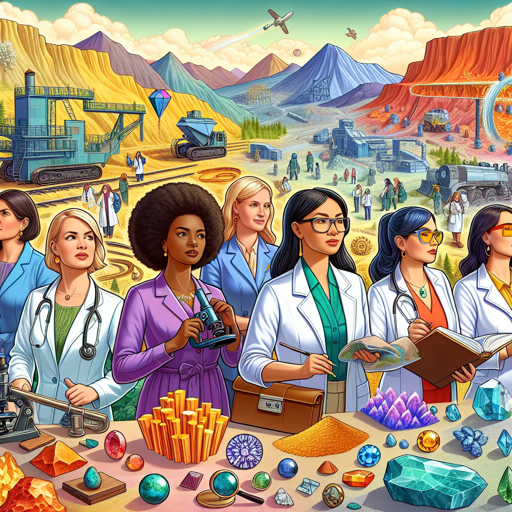
Women Pioneers Who Shaped the World of Geology
Introduction
Geology is a science that unearths stories written in stone, but for centuries, some of the most insightful storytellers were hidden from view. The history of earth sciences and mining is often recounted through the exploits of men, yet countless women have broken barriers, mapped unknown territories, and redefined what it means to be a geologist, mineralogist, or mining leader. Their discoveries and advocacy not only transformed our understanding of the Earth but also changed the very culture of science.
In this article, we celebrate the women who have shaped geology and mining—from spirited Victorian fossil hunters to today’s influential researchers and industry leaders. Whether you’re a geology enthusiast, educator, student, or simply curious about the earth beneath your feet, their stories will inspire you to look deeper.
Early Trailblazers: Breaking Ground in a Man’s World
Mary Anning (1799–1847): The Fossil Finder of Lyme Regis
Mary Anning’s legacy is etched into every geology textbook. Born in Lyme Regis, England, she hunted fossils along the rugged cliffs of the Jurassic Coast, discovering the first complete Ichthyosaurus skeleton at just 12 years old. Despite limited formal education and exclusion from scientific circles due to her gender and class, Anning became a respected fossil expert whose finds rewrote paleontological history.
“The world has used me so unkindly, I fear it has made me suspicious of everyone.”
— Mary Anning
Etheldred Benett (1776–1845): Britain’s First Female Geologist
Etheldred Benett is often called the “Mother of English Geology.” As a landowner in Wiltshire, she collected fossils and meticulously documented stratigraphy. Denied entry into the Geological Society of London for being a woman, Benett nonetheless built connections across Europe. Her collections and correspondence enriched geological knowledge for decades.
Florence Bascom (1862–1945): America’s First Woman Geologist
Florence Bascom shattered academic ceilings by becoming the first woman to receive a Ph.D. in geology from an American university (Johns Hopkins). She was also the first female geologist at the U.S. Geological Survey. Bascom’s pioneering work on crystalline rocks in the Appalachians laid the foundation for geological mapping in North America.
The Twentieth Century: Expanding Horizons
Inge Lehmann (1888–1993): Revealing Earth’s Inner Core
The Danish seismologist Inge Lehmann revolutionized our understanding of Earth’s structure by discovering its solid inner core in 1936. Her careful analysis of earthquake waves provided evidence that overturned prevailing beliefs—an extraordinary achievement in an era when few women were accepted as scientific authorities.
Marie Tharp (1920–2006): Mapping the Mid-Ocean Ridges
Marie Tharp was a geologist and oceanographic cartographer whose maps changed how we view our planet. Working with Bruce Heezen at Columbia University, Tharp used sonar data to chart the Atlantic Ocean floor, revealing the rift valleys that proved the theory of plate tectonics. Her work transformed geoscience—and it all began as she meticulously hand-drew maps while her male counterparts went to sea.
Janet Watson (1923–1985): Leader in British Geology
Janet Watson became the first female President of the Geological Society of London. Her research on Scottish Precambrian rocks advanced our knowledge of ancient tectonic processes. Watson’s leadership opened doors for women across UK earth sciences.
Modern Leaders: Shaping Geology Today
Lisa Tauxe: Magnetic Earth Detective
Lisa Tauxe is a renowned geophysicist whose research on paleomagnetism helps unravel Earth’s magnetic history. Serving as Distinguished Professor at Scripps Institution of Oceanography, her innovative methods have set new standards in rock magnetism and contributed to fundamental theories about plate tectonics.
Kathryn D. Sullivan: From Ocean Depths to Outer Space
Kathryn D. Sullivan’s career spans from geological oceanography to NASA astronaut. As the first American woman to walk in space—and later as Administrator of NOAA—Sullivan bridged earth sciences, oceanography, and space exploration.
Fanja Rabefitia: Advancing Sustainable Mining
Fanja Rabefitia is a Malagasy geologist at the forefront of sustainable mining practices in Madagascar. Her work prioritizes community engagement and environmental stewardship, setting new benchmarks for ethical mining in resource-rich regions.
Table: Influential Women in Geology
| Name | Era | Field/Contribution | Notable Achievements |
|---|---|---|---|
| Mary Anning | 19th century | Paleontology | Discovered Ichthyosaurus; early fossil hunter |
| Etheldred Benett | 18th-19th c. | Stratigraphy & Fossils | Major fossil collection; mapped English strata |
| Florence Bascom | Early 20th c. | Crystalline Petrology | 1st US woman geology Ph.D.; USGS geologist |
| Inge Lehmann | 20th century | Seismology | Discovered Earth’s inner core |
| Marie Tharp | Mid-20th c. | Oceanographic Cartography | Mapped Atlantic rift; proved plate tectonics |
| Janet Watson | Late 20th c. | Structural Geology | 1st female President Geological Society of London |
| Lisa Tauxe | Present | Paleomagnetism | Leading expert; advanced magnetic theory |
| Kathryn D. Sullivan | Present | Oceanography/Space | 1st US woman spacewalk; NOAA administrator |
| Fanja Rabefitia | Present | Sustainable Mining | Promotes ethical mining in Madagascar |
Challenges Faced and Overcome
Women geologists have confronted—and continue to face—significant obstacles: exclusion from academic societies, limited fieldwork opportunities, pay inequity, and persistent stereotypes about women’s abilities in science and industry. Early pioneers like Anning and Benett were denied access to professional organizations; even today, women remain underrepresented in senior roles within mining companies and research institutions.
Despite these challenges, female geoscientists have persevered through:
- Mentorship networks: Many successful women credit support from mentors—both male and female—for their advancement.
- Advocacy organizations: Groups like the Association for Women Geoscientists foster community and promote fair practices.
- Visibility initiatives: Conferences, awards, and field grants specifically for women help increase representation in critical roles.
The Impact on Mineralogy, Mining, and Education
The influence of these women extends far beyond research papers or museum displays:
- Mineralogy: Improved classification systems, discovery of new minerals, and innovative analytical methods.
- Mining: Implementation of safer, more sustainable extraction techniques; advocacy for environmental protections.
- Education: Development of inclusive curricula that represent diverse contributions to earth sciences.
By mentoring new generations and advocating for systemic change, these leaders are transforming how we explore, extract, and teach about our planet.
A Relevant Quote
“Science and everyday life cannot and should not be separated.”
— Rosalind Franklin (chemist and crystallographer)
Continuing Legacy: Inspiring Future Generations
Efforts are ongoing to ensure that women are represented at every level—from field research to boardrooms. Initiatives such as International Women in Mining (IWiM), scholarships for women in STEM, and global networks are helping close the gender gap.
Contemporary role models demonstrate that geology is open to all. Female-led expeditions now explore volcanoes, map ocean floors, discover gemstones, and innovate sustainable mining solutions worldwide.
External Reference
For further reading about women who have changed geology and continue to inspire future generations, visit Geological Society’s Women in Geology.
Conclusion
From fossil-rich cliffs to deep-sea trenches and mineral-rich mines across continents, women have left indelible marks on geology’s past—and are shaping its future. Their passion for discovery has not only solved geological mysteries but also paved new paths for those who follow.
As we celebrate these pioneers and leaders, let us champion greater inclusion so that geology—and all earth sciences—may benefit from every mind inspired by the wonders beneath our feet. Whether you’re picking up your first rock hammer or leading a team into new frontiers, remember: the world needs your perspective.
Explore more stories at Galena.es—where every layer reveals something new.