 Mineral Matrix: An AI Journey into Earth’s Treasures
How Volcanoes Create Gemstones Naturally
Discover the powerful connection between volcanic activity and the birth of stunning gemstones.
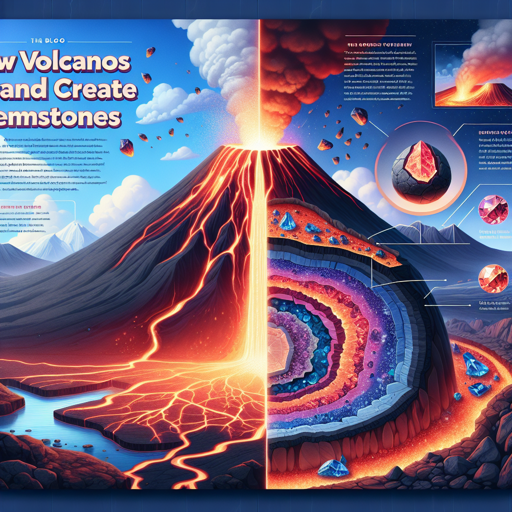
How Volcanoes Create Gemstones Naturally
Introduction
Volcanoes are often associated with fiery eruptions, rivers of molten lava, and dramatic landscapes. But beneath their explosive exterior lies a lesser-known wonder: volcanoes are responsible for creating some of the world’s most beautiful and valuable gemstones. From the dazzling green of peridot to the enchanting play of color in opal, volcanic processes have shaped the mineral treasures we prize today.
For geology enthusiasts, educators, and anyone fascinated by the Earth’s inner workings, understanding how volcanoes contribute to gemstone formation unveils a captivating story of heat, pressure, chemistry, and time. This article delves deep into the intricate relationship between volcanic activity and gemstone creation, exploring the journey from molten magma to magnificent minerals.
The Dynamic World of Volcanoes
Volcanoes are openings in the Earth’s crust where magma, gases, and ash can escape from beneath the surface. They arise at plate boundaries or over hotspots—regions where plumes of hot mantle material rise toward the crust. Volcanic eruptions can be explosive or effusive (lava flows), but every eruption shapes the geology of our planet in unique ways.
Types of Volcanoes
| Type | Description | Example | Gemstone Potential |
|---|---|---|---|
| Shield | Broad, gently sloping; basaltic lava flows | Mauna Loa (Hawaii) | Peridot, Olivine |
| Stratovolcano | Steep, layered; explosive eruptions | Mount St. Helens | Quartz, Opal |
| Cinder Cone | Small, steep-sided; pyroclastic material | Parícutin (Mexico) | Fire Opal |
| Caldera | Large depressions formed after major eruptions | Yellowstone (USA) | Obsidian |
Volcanic activity not only sculpts landscapes but also provides the perfect environment for gemstone formation through rapid cooling, mineral-rich fluids, and high-pressure conditions.
The Science Behind Volcanic Gemstone Formation
1. Heat and Pressure: The Engine of Mineral Creation
Deep beneath the Earth’s surface, extreme heat and pressure drive chemical reactions that form new minerals. As magma rises toward the surface, it cools and solidifies. This cooling process can take thousands or even millions of years, allowing atoms to arrange themselves into beautifully ordered crystal structures—gemstones.
2. Mineral-Rich Magma and Lava
Magma contains a rich mixture of elements: silicon, oxygen, aluminum, magnesium, iron, calcium, potassium, and more. As it cools underground (intrusive) or at the surface (extrusive), different minerals crystallize at different temperatures. Some of these minerals are rare and precious enough to be classified as gemstones.
3. Hydrothermal Fluids: Nature’s Gemstone Factories
After eruptions or as magma cools below ground, hot fluids rich in dissolved minerals percolate through cracks and voids in volcanic rock. As these fluids cool down or interact with other rocks, they deposit minerals that can form gem-quality crystals. Many volcanic gemstones owe their existence to these hydrothermal processes.
Gemstones Born from Fire: Iconic Examples
Let’s explore some of the most stunning gemstones that owe their existence to volcanic activity:
Peridot: The Green Gem from Basalt Flows
Peridot is one of the few gemstones that occurs in only one color—olive green. It forms deep within the mantle and is brought to the surface by basaltic lava flows from shield volcanoes like those in Hawaii. Peridot crystals are often found in volcanic bombs—masses of molten rock ejected during eruptions.
Opal: A Rainbow Born from Volcanic Ash
Opal is renowned for its mesmerizing play-of-color. Many opals form as water percolates through layers of volcanic ash, depositing silica in cracks and cavities. Over millions of years, these silica spheres pack together to create opal’s signature iridescence.
Obsidian: Nature’s Volcanic Glass
Obsidian forms when felsic lava cools so rapidly that crystals do not have time to form, resulting in a glassy texture. Used by early humans for tools and jewelry, obsidian is prized today for its sharpness and deep black luster.
Fire Opal: The Fiery Gem from Mexico
Fire opal is a transparent to translucent variety with warm body colors ranging from yellow to orange to red. It forms in volcanic rocks—especially rhyolite—and is famously mined in Mexico.
Other Notable Volcanic Gemstones
- Garnet (in some lava flows)
- Spinel (in basalt)
- Zircon (in volcanic tuffs)
- Moonstone (in volcanic pegmatites)
- Topaz (in rhyolitic cavities)
Table: Volcanic Gemstones and Their Origins
| Gemstone | Formation Environment | Typical Volcano Type | Notable Locations |
|---|---|---|---|
| Peridot | Basaltic lava flows | Shield volcano | Hawaii, Arizona, Myanmar |
| Opal | Silica-rich volcanic ash | Stratovolcano/cinder | Australia, Ethiopia, Mexico |
| Obsidian | Rapidly cooled lava | Caldera/stratovolcano | USA (Oregon), Armenia |
| Fire Opal | Rhyolitic volcanic rock | Cinder cone | Mexico |
| Garnet | Lava & volcanic tuffs | Various | Tanzania, Kenya |
| Spinel | Basalt | Shield/stratovolcano | Sri Lanka, Vietnam |
The Role of Plate Tectonics
Volcanoes do not exist in isolation—they are part of a dynamic planet shaped by plate tectonics. Plate movements create subduction zones (where one plate dives beneath another), rift valleys (where plates pull apart), and hotspots (stationary plumes). Each setting creates unique conditions for gemstone formation:
- Subduction Zones: Water-rich magmas can form rare gems like topaz.
- Rift Valleys: Basalt flows may bring up mantle minerals like peridot.
- Hotspots: Isolated volcanoes produce unique gems due to their distinct chemistry.
Mining Volcanic Gemstones: From Earth to Market
Extracting gemstones from volcanic environments is both an art and a science. Some gems are collected from surface deposits after eruptions; others require tunneling into ancient lava flows or sifting through alluvial deposits created by weathering.
Key Mining Methods
- Surface Collection: Gems exposed by erosion or recent eruptions.
- Alluvial Mining: Sifting through riverbeds for water-worn stones.
- Hard Rock Mining: Drilling and blasting into solidified lava or tuff layers.
Ethical mining practices are crucial to minimize environmental impact and ensure fair labor practices in gem-producing regions.
Quote
“Volcanoes are cradle and crucible—their fiery breath forges not only landforms but also some of our planet’s greatest treasures.”
— Dr. Hazel Stone, Geologist & Author
Educational Insights: Teaching About Volcanic Gemstones
For educators and students alike, volcanic gemstones offer a tangible way to connect earth science concepts with real-world wonders. Classroom activities can include:
- Crystal Growing Experiments: Simulate mineral formation.
- Field Trips: Visit local volcanic sites or museums.
- Gemstone Identification Labs: Study physical properties like hardness, luster, and color.
By investigating where and how gemstones form, students gain deeper insight into geology, chemistry, plate tectonics, and environmental science.
Volcanic Gemstones vs. Other Origins
Not all gemstones come from volcanoes! Some famous gems form in metamorphic rocks (e.g., sapphires), sedimentary rocks (e.g., turquoise), or even by biological processes (e.g., pearls). Here is a quick comparison:
| Origin Type | Examples | Typical Environment |
|---|---|---|
| Volcanic | Peridot, Opal, Obsidian | Lava flows, ash beds |
| Metamorphic | Sapphire, Emerald | High-pressure zones |
| Sedimentary | Turquoise, Malachite | Weathered rocks |
| Organic | Pearl, Amber | Biological processes |
Understanding these differences helps gemologists identify stones and trace their geological history.
Further Reading & Resources
For those eager to explore more about gems born from fire:
- Gemological Institute of America – How Gems Are Formed
- USGS – Volcanoes & Mineral Resources
- Mindat.org – Minerals by Geological Environment
Conclusion
The awe-inspiring power of volcanoes extends far beyond their ability to reshape landscapes—they are also master craftsmen of nature’s most dazzling jewels. Through processes involving heat, pressure, chemistry, and time, volcanoes create an array of unique gemstones treasured around the world.
For geology enthusiasts and gemstone lovers alike, exploring the origins of these stones deepens our appreciation for the dynamic forces that shape our planet. So next time you admire a glittering opal or a lush green peridot, remember: its story began in the heart of a volcano.