 Mineral Matrix: An AI Journey into Earth’s Treasures
Earth Science Activities for Curious Classrooms
Hands-on experiments and projects to spark curiosity in geology and earth sciences.
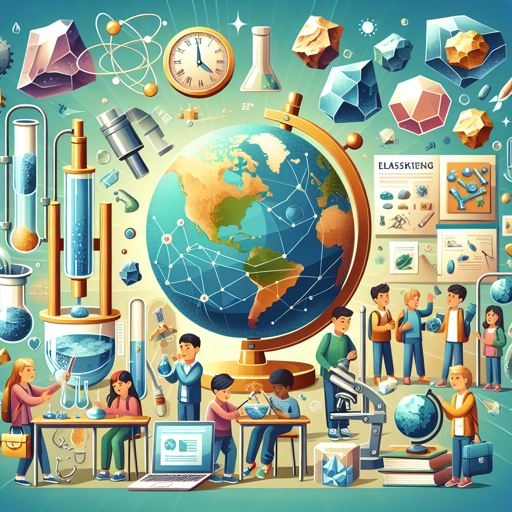
Introduction
Earth science is more than just memorizing rock names or learning about the Earth’s layers—it’s about discovery, curiosity, and understanding the dynamic planet we call home. For students of all ages, hands-on activities and engaging projects transform abstract geological concepts into vivid, memorable experiences. Whether you’re an educator seeking ways to energize your earth science curriculum or a geology enthusiast eager to share your passion, this comprehensive guide will provide a variety of classroom-tested activities that make learning about minerals, rocks, fossils, and Earth’s processes both accessible and exciting.
“The best way to learn science is to do science.”
— Neil deGrasse Tyson
In this article, we’ll explore a collection of earth science activities for classrooms—ranging from simple experiments demonstrating mineral properties to creative projects modeling geological phenomena. These activities are designed to foster inquiry, promote scientific thinking, and help students develop a lasting appreciation for the wonders beneath our feet.
Why Hands-On Earth Science Activities Matter
Research consistently shows that active learning strategies—such as experiments, model-building, and field investigations—enhance engagement and retention in science education. Students who participate in interactive activities are more likely to:
- Grasp complex earth science concepts,
- Develop critical observation and analytical skills,
- Foster curiosity about the natural world,
- Make connections between classroom learning and real-world phenomena.
Classroom activities also break down the barriers between textbook knowledge and the dynamic processes shaping our planet every day.
Essential Supplies for Earth Science Activities
Before diving into specific projects, it’s helpful to assemble a basic toolkit for geology experiments. Here’s a handy table outlining useful materials and their purposes:
| Material | Purpose/Use | Suggested Activities |
|---|---|---|
| Hand lens/magnifying glass | Examining minerals, rocks, fossils | Mineral identification, rock texture analysis |
| Streak plates | Testing mineral color in powdered form | Mineral identification lab |
| Magnet | Detecting magnetic minerals (e.g., magnetite) | Mineral property testing |
| Vinegar (acetic acid) | Testing for carbonate minerals | Acid reaction experiments |
| Clear plastic cups | Observing sediment layers, water cycles | Sediment jar demo, water cycle experiments |
| Plaster of Paris/Clay | Making fossil casts and models | Fossil creation, volcano models |
| Food coloring | Tracing water movement in experiments | Groundwater flow, erosion demos |
| Sand/Gravel/Rocks | Simulating sedimentation and erosion | Stream tables, soil permeability tests |
| Rulers/Measuring tape | Measuring landforms or sediment layers | Topographic mapping, stream erosion studies |
| Globe or maps | Teaching plate tectonics or landforms | Continental drift models, map reading |
Activity 1: Mineral Identification Lab
Objective
Help students learn how geologists identify minerals using observable properties.
Procedure
- Gather Samples: Provide 6–10 mineral specimens with varying properties (e.g., quartz, calcite, pyrite).
- Observation: Using a hand lens, students record characteristics such as color, luster (shiny or dull), streak (color of powder), hardness (Mohs scale test), and reaction to vinegar.
- Testing: Have students gently scratch minerals with a nail or penny to determine hardness.
- Record & Compare: Students fill in an identification chart and use a simple dichotomous key to determine each mineral’s name.
Tip: Encourage students to hypothesize before testing—what property will help them identify the mineral fastest?
Activity 2: Building Edible Earth Layers
Objective
Visualize Earth’s internal structure using creative, edible materials.
Procedure
- Materials: Use a large marshmallow (inner core), chocolate syrup (outer core), vanilla pudding (mantle), and crushed cookies (crust).
- Assembly: Layer the ingredients in a clear cup in correct order.
- Discussion: As students eat their “Earth,” discuss each layer’s composition and importance.
- Extension: Compare Earth’s structure with that of other planets using online resources or models.
Learning Outcome: This tasty project reinforces understanding of the Earth’s interior while appealing to multiple senses.
Activity 3: Simulating Erosion with a Stream Table
Objective
Demonstrate how water shapes landscapes through erosion and deposition.
Procedure
- Set Up: Fill a plastic tray with sand and gravel. Tilt the tray slightly.
- “Rainfall”: Slowly pour water from a cup at one end to simulate rainfall or river flow.
- Observation: Watch as channels form and sediment is carried downstream.
- Variables: Experiment by adding obstacles (rocks or twigs) to see how they alter water flow.
Discussion Points:
- How do rivers create valleys?
- What happens during floods?
- How do human activities impact erosion?
Activity 4: Modeling Plate Tectonics with Crackers
Objective
Visualize plate boundaries and tectonic movements using common snacks.
Procedure
- Materials: Use graham crackers (lithospheric plates) and whipped cream or frosting (asthenosphere).
- Construct: Spread a layer of whipped cream on a plate. Place two cracker “plates” side by side on top.
-
Experiment:
- Push plates together—observe mountain building (convergent boundary).
- Pull them apart—see rift valleys form (divergent boundary).
- Slide them past each other—model earthquakes (transform boundary).
Reflection: Which real-world boundaries do these actions represent? Map famous boundaries like the San Andreas Fault.
Activity 5: Growing Crystals—The Science of Mineral Formation
Objective
Explore how minerals grow from solutions through crystal formation.
Procedure
- Materials: Water, table salt or sugar, clear cups, string, pencils.
- Dissolve: Mix salt or sugar into hot water until no more dissolves (saturated solution).
- Seed Crystals: Tie string to a pencil; suspend it in the solution so it doesn’t touch the sides.
- Wait: Over several days, crystals will form along the string as water evaporates.
Extension Ideas:
- Try different solutes (alum, borax).
- Compare crystal shapes under a magnifier.
Activity 6: Fossilization in Action—Making Plaster Fossils
Objective
Simulate fossil formation and learn about paleontology.
Procedure
- Materials: Modeling clay, shells/leaves/small bones, Plaster of Paris.
- Impress: Press objects into clay to make an imprint.
- Cast: Pour mixed plaster into the imprint. Let it harden.
- Reveal: Remove the plaster “fossil” and compare with real fossil images.
Discussion: Discuss which conditions favor fossilization and why some creatures are more likely to fossilize than others.
Activity 7: Soil Permeability Testing
Objective
Investigate how soil composition affects water flow—key for understanding groundwater and agriculture.
Procedure
- Materials: Funnels, coffee filters, jars/beakers, various soil types (sand, clay, garden soil), water.
- Test: Place soil in a funnel lined with a coffee filter; pour equal amounts of water into each.
- Measure: Time how long it takes for water to drain through each soil type.
- Analyze: Chart results and discuss implications for farming and construction.
Activity 8: Creating Topographic Maps with Clay
Objective
Help students grasp three-dimensional landforms using hands-on mapping.
Procedure
- Mold Landforms: Build hills or mountains from modeling clay.
- Slice Horizontally: Use thread or a wire to cut horizontal slices at set intervals.
- Trace Layers: Lay slices flat on paper; trace each layer to create a contour map.
- Interpretation: Teach how contour lines show elevation changes on real maps.
Comparing Activities: Skills & Concepts Table
Here’s a comparison table highlighting which core earth science skills are developed by each activity:
| Activity | Observation | Experimentation | Modeling | Data Analysis |
|---|---|---|---|---|
| Mineral Identification | ✓ | ✓ | ✓ | |
| Edible Earth Layers | ✓ | ✓ | ||
| Stream Table Erosion | ✓ | ✓ | ✓ | ✓ |
| Plate Tectonics Crackers | ✓ | |||
| Growing Crystals | ✓ | ✓ | ✓ | |
| Plaster Fossils | ✓ | |||
| Soil Permeability | ✓ | ✓ | ✓ | |
| Topographic Maps | ✓ |
Tips for Successful Earth Science Activities
- Safety First! Always review safety guidelines for materials used in experiments, especially with younger students.
- Encourage Inquiry: Let students ask questions and design their own variations of experiments.
- Utilize Technology: Incorporate interactive simulations or apps for topics like earthquakes or mineral identification.
- Connect Locally: Bring in local rocks or minerals to make lessons relevant to your region.
- Field Trips: If possible, organize visits to museums, quarries, or natural sites for first-hand learning.
Resources for Further Exploration
For educators seeking more ideas or detailed lesson plans, consider exploring these reputable sources:
- American Geosciences Institute - Classroom Activities
- National Park Service - Geology Resources
- Smithsonian National Museum of Natural History - Education
Conclusion
Engaging earth science activities don’t require expensive equipment or elaborate setups—they’re about sparking curiosity through observation, experimentation, and creative exploration. By bringing geology alive in the classroom with experiments on mineral identification, edible models of Earth’s interior, erosion demonstrations, crystal growing projects, and more, educators can nurture the next generation of geoscientists and earth stewards.
Remember: The rocks beneath our feet tell stories spanning millions of years—and with the right activities, every student can learn to read them.
“Tell me and I forget. Teach me and I remember. Involve me and I learn.”
— Benjamin Franklin
Let’s make earth science not just something we study—but something we experience!
For more inspiration and resources on minerals, mining, gemstones, and geology education, stay tuned to our blog and keep exploring the fascinating world beneath your feet!