 Mineral Matrix: An AI Journey into Earth’s Treasures
The Science Behind Birthstones
Explore the geology and myths that make birthstones captivating treasures.
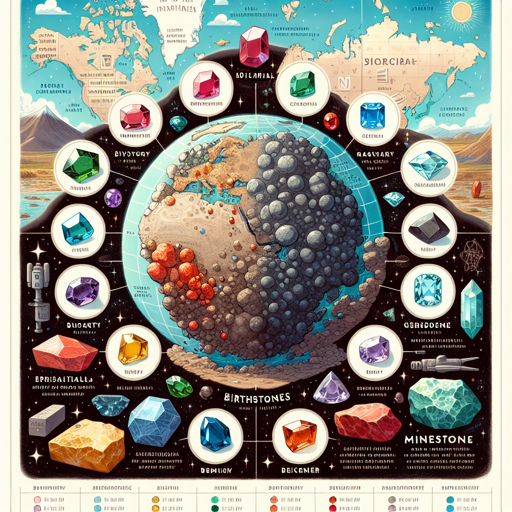
Introduction
Birthstones have long captivated the human imagination. For centuries, these dazzling minerals and gems have been prized not just for their beauty but also for their supposed mystical powers and deep historical roots. Whether you wear a shimmering sapphire or keep a fiery garnet close, birthstones are more than just adornments—they are windows into the fascinating worlds of geology, culture, and myth.
But what truly makes a gemstone a “birthstone”? What distinct geological journeys do these minerals travel before they find their place in jewelry and legend? And why do societies across the globe attribute such significance to these colorful stones? In this article, we’ll dig deep into the science behind birthstones, unearthing the stories of their formation, exploring the myths that surround them, and appreciating the intricate connections between Earth’s processes and human culture.
“Gemstones are nature’s poetry written in the language of geology.”
— Dr. Emily Carter, Geologist and Gemologist
The Origins of Birthstone Traditions
The tradition of assigning gemstones to months dates back thousands of years. The earliest known connection is often traced to the Breastplate of Aaron described in the Book of Exodus in the Bible, where 12 stones represented the tribes of Israel. Over time, this concept evolved through various cultures including ancient Rome, India, and medieval Europe.
For centuries, different lists of birthstones have existed, varying by culture and era. The most widely recognized modern list was standardized in 1912 by the American National Retail Jewelers Association (now Jewelers of America), with occasional updates reflecting new discoveries and market trends.
Geological Formation: How Birthstones Are Born
Each birthstone’s story begins deep within the Earth, where geological processes over millions of years create these mineral marvels. The science behind each gem is as unique as the stone itself.
Gem Formation Processes
- Igneous Processes: Some gemstones crystallize from molten rock (magma or lava). Examples include peridot (August) and garnet (January).
- Metamorphic Processes: Heat and pressure transform existing minerals into new gems. Sapphire (September) and emerald (May) often form this way.
- Sedimentary Processes: Water movement deposits minerals in layers, forming gems like opal (October) and turquoise (December).
The Role of Trace Elements
What gives each gemstone its color? Tiny amounts of specific elements! For instance, chromium turns beryl into emerald green, while iron gives amethyst (February) its purple hue. These trace elements are crucial for creating the unique palette that birthstones display.
Table: Birthstones by Month – Geology at a Glance
| Month | Birthstone(s) | Geological Origin | Key Element(s) | Notable Localities |
|---|---|---|---|---|
| January | Garnet | Metamorphic/Igneous | Iron, Magnesium | India, USA, Africa |
| February | Amethyst | Igneous | Iron | Brazil, Zambia |
| March | Aquamarine | Igneous/Metamorphic | Iron | Brazil, Pakistan |
| April | Diamond | Mantle-derived Igneous | Carbon | Russia, Botswana |
| May | Emerald | Metamorphic | Chromium, Vanadium | Colombia, Zambia |
| June | Pearl/Alexandrite | Organic/Igneous | Calcium/Chromium | Japan/Sri Lanka |
| July | Ruby | Metamorphic | Chromium | Myanmar, Thailand |
| August | Peridot | Igneous (Olivine) | Iron, Magnesium | USA, China |
| September | Sapphire | Metamorphic/Igneous | Iron, Titanium | Sri Lanka, Madagascar |
| October | Opal/Tourmaline | Sedimentary/Pegmatite | Silica/Varied | Australia/Brazil |
| November | Topaz/Citrine | Igneous/Pegmatite | Aluminum/Iron | Brazil/Russia |
| December | Turquoise/Tanzanite | Sedimentary/Metamorphic | Copper/Vanadium | Iran/Tanzania |
Birthstone Myths and Cultural Significance
Throughout history, birthstones have been believed to bring luck, protection, healing, and even divine favor. Let’s explore the legends that surround some of these captivating stones:
Garnet (January)
Once considered a symbol of protection for travelers and warriors, garnet was worn in ancient Rome to ward off evil and disaster.
Amethyst (February)
The Greeks believed this purple quartz could prevent intoxication. The name comes from “amethystos,” meaning “not drunken” in Greek.
Diamond (April)
Diamonds have symbolized strength and invincibility since antiquity. Their unmatched hardness is a geological marvel—diamonds form under extreme pressure deep within Earth’s mantle.
Emerald (May)
Revered by ancient Egyptians as a symbol of rebirth and eternal youth. Cleopatra famously adorned herself with emeralds.
Pearl (June)
Unlike other birthstones, pearls are organic—created by mollusks rather than geological processes. They’ve long symbolized purity and wisdom.
Ruby (July)
Ancient Hindus called rubies “ratnaraj,” or king of gems. Rubies were believed to hold the power of life due to their vibrant red color.
Sapphire (September)
Associated with nobility and divine favor, sapphires were worn by medieval clergy to symbolize heaven.
Opal (October)
Opal’s play-of-color made it a stone of inspiration and prophecy in ancient Rome. In medieval Europe, it was thought to bring good fortune.
Turquoise (December)
Native American cultures prized turquoise as a protective amulet and symbol of sky and water.
Modern Science Meets Ancient Lore
While science has demystified much about gemstones—revealing their atomic structures, growth conditions, and properties—the allure of birthstones persists. Today’s gemologists use advanced tools such as spectroscopy and electron microscopy to uncover secrets about inclusions and trace elements that give each stone its unique fingerprint.
Yet despite these advances, the stories we tell about birthstones remain powerful. Whether you’re drawn to garnet’s fiery red because you’re a January baby or appreciate sapphire’s celestial blue for its beauty alone, these stones continue to connect us to Earth’s deep history and human culture.
Birthstone Alternatives and Ethical Mining
As awareness grows about the environmental impact of mining and concerns over “blood diamonds” or unsustainable practices rise, many consumers seek ethically sourced or lab-grown alternatives.
- Lab-grown Gems: Chemically identical to natural stones but created in controlled environments.
- Recycled Gems: Vintage stones reused in new jewelry.
- Certified Ethical Mining: Organizations like the Responsible Jewellery Council promote transparency and fair labor practices.
For educators and enthusiasts alike, understanding where your birthstone comes from—and how it was sourced—adds another layer of appreciation for these geological treasures.
Visual Guide: Birthstone Colors at a Glance
A quick look at the vivid spectrum represented by each month’s birthstone:
| Month | Birthstone(s) | Primary Color(s) |
|---|---|---|
| January | Garnet | Deep Red |
| February | Amethyst | Purple |
| March | Aquamarine | Pale Blue |
| April | Diamond | Colorless (varies) |
| May | Emerald | Vivid Green |
| June | Pearl/Alexandrite | White/Color-changing |
| July | Ruby | Vivid Red |
| August | Peridot | Olive Green |
| September | Sapphire | Deep Blue |
| October | Opal/Tourmaline | Multi-color/Pink-Green |
| November | Topaz/Citrine | Golden Yellow |
| December | Turquoise/Tanzanite | Blue to Violet |
Teaching with Birthstones: A Gateway to Geology
Birthstones offer an engaging introduction to mineralogy for students. By exploring their formation environments—igneous, metamorphic, sedimentary—learners connect abstract geological concepts with tangible examples. Activities might include:
- Mineral Identification Labs: Using real or replica birthstones.
- Geographical Mapping: Tracing where major deposits are found.
- Cultural Research Projects: Investigating myths across cultures.
- Ethical Debates: Discussing mining practices and sustainability.
Birthstones are not just beautiful; they are exceptional educational tools bridging geology with history, geography, chemistry, and ethics.
External Reference
For further reading on gemstone geology and history:
Smithsonian National Museum of Natural History - Gem Gallery
Conclusion
From their dramatic origins deep within Earth’s crust to their prominent roles in myth and culture, birthstones are more than mere tokens—they are storytellers. Each stone encapsulates eons of geological activity as well as centuries of human belief and artistry.
Whether you’re a seasoned collector, an educator seeking inspiration for your next lesson plan, or simply someone who appreciates the beauty of natural wonders, birthstones offer a fascinating intersection between science and story. By learning about the geology that creates them and the myths that surround them, we not only enrich our understanding of minerals but also deepen our appreciation for the enduring relationship between people and planet Earth.
So next time you slip on a ring or admire a pendant set with your birthstone, remember: you’re carrying a piece of Earth’s own narrative—a narrative written in atoms, shaped by time, colored by nature, and cherished by humanity.