 Mineral Matrix: An AI Journey into Earth’s Treasures
The Science Behind Crystal Formation
Discover how minerals form stunning crystals deep within Earth
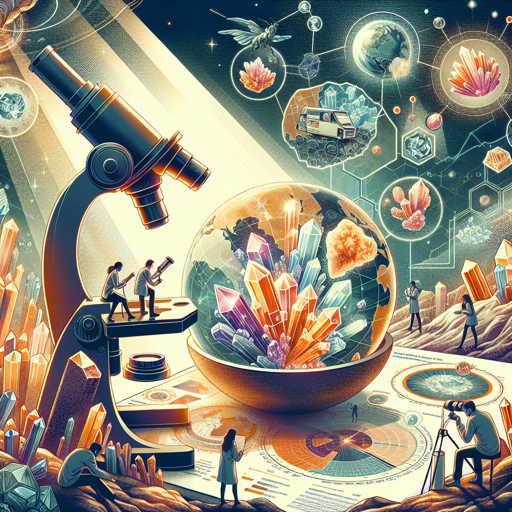
The Science Behind Crystal Formation
Introduction
From the captivating sparkle of gemstones to the mesmerizing geometric patterns of snowflakes, crystals have long fascinated humanity. But how do these enchanting structures form deep within the Earth? What secrets are locked within their lattice frameworks? Whether you’re a geology enthusiast, an educator, a student, or simply curious about the natural wonders beneath our feet, understanding the science behind crystal formation opens a window to the dynamic processes shaping our planet. In this article, we will unravel the mysteries of crystal growth, the conditions required for their development, and the incredible diversity of forms they take.
What Is a Crystal?
At its core, a crystal is a solid substance in which the constituent atoms, ions, or molecules are arranged in an orderly repeating pattern extending in all three spatial dimensions. This regularity is what gives crystals their characteristic shapes and remarkable physical properties. Minerals—the building blocks of rocks—often crystallize under specific environmental conditions, producing everything from microscopic grains to large, gem-quality specimens.
Crystallography: The Study of Crystals
Crystallography is the scientific discipline that examines the arrangement of atoms in crystalline solids and how this arrangement influences physical properties. It’s through crystallography that we’ve come to understand why quartz forms six-sided prisms or why halite (rock salt) typically exhibits cubic shapes.
How Do Crystals Form? The Building Blocks
Crystal formation, or crystallization, is driven by changes in temperature, pressure, and chemical environment. There are several key processes by which crystals emerge:
1. Solidification from a Melt
When molten rock (magma or lava) cools and solidifies, minerals begin to crystallize out of the melt. The rate of cooling dramatically affects crystal size:
- Slow cooling (deep underground): Allows atoms time to arrange themselves into large, well-formed crystals (e.g., granite’s feldspar and quartz).
- Fast cooling (surface eruptions): Results in smaller crystals or even glassy textures (e.g., obsidian).
2. Precipitation from Solution
Crystals can also form when elements or compounds dissolved in water become supersaturated and start to precipitate:
- Evaporation: As water evaporates, substances like halite or gypsum crystallize out (think salt flats).
- Temperature or pressure changes: Can reduce solubility, causing minerals like calcite to precipitate in caves (stalactites and stalagmites).
3. Sublimation
Some crystals form directly from a gas without passing through a liquid phase—this is called sublimation. For example, sulfur crystals can develop around volcanic vents where sulfur-rich gases cool rapidly.
4. Metamorphism
During metamorphism—when rocks are subjected to high pressures and temperatures—minerals may recrystallize into new forms without melting. Garnet and kyanite are classic examples of metamorphic crystals.
Crystal Systems: Nature’s Geometry
Crystals exhibit stunning geometric regularity because their atomic arrangements repeat in specific patterns. Scientists classify these into seven crystal systems based on symmetry and unit cell dimensions:
| Crystal System | Key Axes/Angles | Common Examples |
|---|---|---|
| Cubic (Isometric) | Three equal axes at 90° | Halite, Pyrite |
| Tetragonal | Two equal, one unequal axis at 90° | Zircon |
| Orthorhombic | Three unequal axes at 90° | Olivine, Topaz |
| Hexagonal | Four axes; three at 120°, one perp. | Quartz, Beryl |
| Trigonal (Rhombo.) | Three equal axes at 120°, one perp. | Calcite |
| Monoclinic | Three unequal axes; one not at 90° | Gypsum |
| Triclinic | Three unequal axes; no right angles | Kyanite |
This geometric classification helps mineralogists identify minerals and interpret their growth environments.
Factors Affecting Crystal Growth
Not all crystals are created equal—even the same mineral can form different crystal habits (shapes) depending on its environment. Several factors control how crystals grow:
1. Supersaturation
Crystals only form when a solution becomes saturated with dissolved material; further increase leads to supersaturation and triggers precipitation.
2. Temperature and Pressure
Higher temperatures generally increase atom mobility, aiding in larger crystal growth—provided cooling happens gradually. Pressure influences which minerals can stably crystallize; diamonds, for example, require immense pressures found deep in Earth’s mantle.
3. Space and Time
Limited space results in smaller or intergrown crystals (as in basalt), while ample space lets large crystals flourish (e.g., geodes).
4. Impurities
Impurities can distort crystal lattices or be incorporated as trace elements, leading to color variations (such as amethyst’s purple hue due to iron impurities in quartz).
“In every crystal we see not only the order of matter but also the invisible hand of Earth’s restless energy.” — Dr. Jane McKinnon, Geologist
Iconic Examples of Crystal Formation
Some of the world’s most breathtaking mineral specimens owe their existence to unique geological conditions:
Giant Selenite Crystals: Naica Mine, Mexico
The Cave of Crystals harbors selenite (gypsum) crystals up to 12 meters long! These formed over hundreds of thousands of years in a hot, mineral-rich solution within an underground chamber.
Gemstone-Quality Diamonds
Natural diamonds crystallize under extreme pressure and temperature some 140–190 kilometers beneath Earth’s surface, later brought up by volcanic eruptions.
Snowflakes: Nature’s Ephemeral Crystals
Snowflakes are fleeting hexagonal ice crystals that grow as water vapor freezes in cold clouds—each with its own unique symmetry.
Crystals Beyond Earth: Meteorites and Space Minerals
Crystals aren’t limited to terrestrial settings. Some meteorites contain rare minerals like perovskite or stishovite, formed by high-energy impacts or in asteroid interiors. The study of these extraterrestrial crystals offers clues about planetary formation across the solar system.
Why Do Crystals Matter?
Understanding crystal formation is more than an academic pursuit:
- Mining and Industry: Many metals (copper, lead, zinc) are extracted from ore minerals that crystallized in ancient hydrothermal veins.
- Gemology: The value of gemstones depends on the quality and perfection of their crystal structures.
- Earth Science Education: Crystals reveal conditions deep within Earth—paleo-temperatures, pressures, and fluid histories.
- Technology: Crystalline silicon powers our electronics; synthetic quartz oscillators keep time in watches.
Table: Comparing Crystal Formation Processes
| Formation Process | Environment | Typical Minerals | Key Features |
|---|---|---|---|
| Magmatic (Solidify) | Igneous/Volcanic | Quartz, Feldspar | Large/small crystals based on cooling rate |
| Precipitation | Sedimentary/Hydrothermal | Halite, Calcite | Forms from saturated solutions |
| Metamorphic Growth | Deep crust | Garnet, Kyanite | Recrystallization under pressure |
| Sublimation | Volcanic surface | Sulfur | Direct gas-to-solid transition |
Resources for Further Exploration
For those eager to deepen their understanding:
- Mineralogy Database: Crystallography
- USGS: How Do Minerals Form?
- American Mineralogist: Crystal Growth Studies
Conclusion
From deep magmatic chambers to shimmering snowflakes drifting from the sky, crystal formation is a testament to nature’s artistry and scientific complexity. Each crystal encodes information about its origins—temperature, pressure, chemistry, time—waiting for geologists to unlock its story. Whether you marvel at gemstones or study minerals under a microscope, remember: within every crystal lies the blueprint of Earth’s dynamic processes.
Continue your journey into mineralogy and geology—because every crystal is a clue to our planet’s fascinating past.
For more insights into minerals and crystalline wonders, explore additional guides and news at Galena.es.