 Mineral Matrix: An AI Journey into Earth’s Treasures
The Science Behind Gemstone Colors Explained
Uncover the chemistry and physics behind gemstone hues and what makes their colors so captivating to the human eye.
Introduction
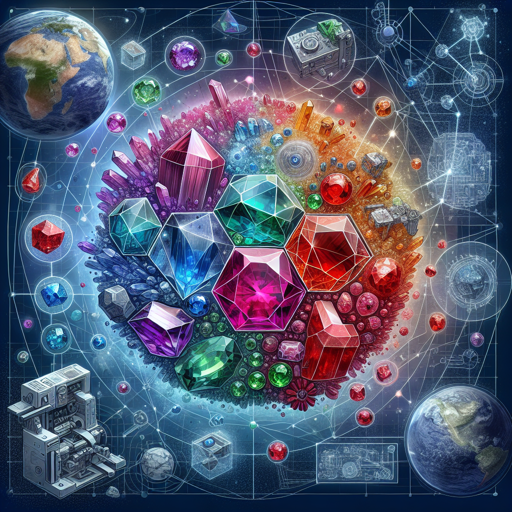
From the fiery red of rubies and the deep blue of sapphires to the dazzling green of emeralds, gemstones have captivated human imagination for millennia. But what is it that gives these precious stones their vivid, distinctive hues? The science behind gemstone color is a fascinating interplay of chemistry, physics, and geology. Understanding why gemstones display such a vast spectrum of colors not only deepens our appreciation for their beauty but also reveals important insights into the Earth’s history and the atomic world.
Whether you’re a geology enthusiast, educator, student, or simply a lover of all things sparkly, this article will guide you through the intricate science that paints our world with the colors of gems. Prepare to journey into the microscopic realm where light, atoms, and minerals converge to create some of Earth’s most dazzling treasures.
The Basics: How Do We See Color?
Before delving into gemstones, it’s essential to understand how color is perceived. Color is not an inherent property of an object; rather, it results from the interaction between light and matter.
When white light (which contains all visible wavelengths) strikes an object, certain wavelengths are absorbed while others are reflected or transmitted. The colors we see are those wavelengths that reach our eyes after this interaction.
In gemstones, this selective absorption and reflection are largely determined by their chemical composition and crystal structure. These factors dictate how gemstones interact with light—and thus, what colors are produced.
The Role of Chemical Elements: Chromophores
At the heart of gemstone color lie chromophores—elements or compounds that absorb specific wavelengths of light. In the world of minerals, trace amounts of certain elements can dramatically alter a gemstone’s appearance.
The table below summarizes some key chromophores and the colors they typically produce:
| Chromophore | Common Gemstones | Typical Color Produced |
|---|---|---|
| Chromium (Cr) | Emerald, Ruby | Green (emerald), Red (ruby) |
| Iron (Fe) | Amethyst, Aquamarine | Purple (amethyst), Blue-green (aquamarine) |
| Titanium (Ti) | Sapphire (with Fe) | Blue |
| Copper (Cu) | Turquoise, Paraiba Tourmaline | Blue, Green |
| Manganese (Mn) | Spessartine Garnet, Rhodochrosite | Orange, Pink/Red |
| Vanadium (V) | Emerald | Green |
These minute impurities—sometimes in concentrations as low as parts per million—can be responsible for the entire color palette of gemstones.
Crystal Field Theory
How exactly do these elements impart color? The answer lies in crystal field theory. Transition metal ions like chromium or iron have electrons in their d-orbitals. When these ions are surrounded by neighboring atoms in a crystal lattice, their electronic energy levels split. Light of specific energies (wavelengths) can be absorbed to promote electrons between these split levels—resulting in color.
For example:
- Emerald’s rich green comes from chromium ions absorbing red and blue light but reflecting green.
- Ruby’s red glow arises because chromium absorbs green and blue light, transmitting red.
Structural Influences: The Role of Crystal Lattice
Not all color in gemstones comes from impurities. Sometimes, the arrangement of atoms within the crystal structure itself can influence color.
Allochromatic vs. Idiochromatic Gemstones
- Idiochromatic gems derive their color from essential constituents of their chemical composition (e.g., peridot’s green from iron).
- Allochromatic gems get their color from trace impurities (e.g., corundum is colorless when pure; chromium or iron/titanium turns it into ruby or sapphire).
Color Centers
A color center is a defect in the crystal lattice—such as a missing atom or an extra electron—that can absorb certain wavelengths of light and cause coloration. Smoky quartz gets its brown hue from such defects created by natural radiation over time.
Physical Phenomena: Beyond Chemistry
While chemistry plays a vital role in determining gemstone color, several physical phenomena can also influence or enhance these hues:
Pleochroism
Some anisotropic gemstones display different colors when viewed from different angles. This phenomenon—pleochroism—occurs because light traveling through different crystallographic directions is absorbed to different extents.
Example: Iolite can appear violet-blue from one angle and pale yellow from another.
Dispersion
Dispersion refers to a gemstone’s ability to split white light into its spectral components (think of diamond’s “fire”). Higher dispersion leads to more vivid flashes of rainbow color.
Interference Colors
Gems like opal and labradorite display iridescence due to interference effects as light waves reflect off microscopic structures inside the stone.
Treatment and Enhancement: Changing Gemstone Colors
Human ingenuity has found ways to alter or enhance gemstone colors for both beauty and commercial appeal. Some common methods include:
- Heat treatment: Used to intensify or change color in sapphires, rubies, and topaz.
- Irradiation: Alters color centers in gems like blue topaz.
- Dyeing: Applies artificial colors to porous stones like agate or jade.
- Coating: Deposits thin films on gems to modify surface color.
It’s important for collectors and buyers to know whether a gemstone’s color is natural or treated—a fact often disclosed in reputable gemological certifications.
A Closer Look: Famous Gemstones and Their Colors
Let’s examine how science explains the iconic colors of some world-famous gems:
| Gemstone | Source of Color | Notable Example |
|---|---|---|
| Ruby | Chromium ions | The Sunrise Ruby |
| Sapphire | Iron + Titanium ions | The Star of India |
| Emerald | Chromium + Vanadium ions | The Chalk Emerald |
| Diamond | Structural defects/nitrogen | The Hope Diamond (blue) |
Quote
“Gemstones are Earth’s own stained glass—each colored by the invisible dance between atoms and light.”
— Dr. Emily Carter, Mineralogist
Why Do Some Gemstones Change Color?
Color-change gemstones—like alexandrite—are among nature’s rarest wonders. Alexandrite appears green in daylight and red under incandescent light. This dramatic shift arises because its chromium ions absorb different parts of the spectrum depending on the light source. The phenomenon is known as metamerism.
Other stones, like garnet varieties, also display such optical magic due to complex interactions between their chemical makeup and the nature of incident light.
Spectroscopy: Decoding Gemstone Colors
Modern mineralogy uses spectroscopy—the analysis of light absorbed or emitted by materials—to identify gemstones and understand their coloration mechanisms. Each gemstone has a unique absorption spectrum that acts like a fingerprint for its identification.
Spectroscopy can reveal:
- The presence and type of chromophores
- Whether a gem’s color is natural or result of treatment
- Subtle differences between visually similar stones
Table: Key Factors Affecting Gemstone Color
| Factor | Description | Example |
|---|---|---|
| Chemical Composition | Presence of chromophores; trace elements | Chromium in ruby |
| Crystal Structure | Arrangement of atoms; idiochromatic/allochromatic | Beryl structure in emerald |
| Color Centers | Lattice defects absorbing specific wavelengths | Smoky quartz |
| Physical Phenomena | Pleochroism, dispersion, interference | Iolite (pleochroism), Opal (play-of-color) |
| Treatments | Human-induced changes | Heat-treated sapphire |
For Further Reading
To deepen your understanding of gemstone coloration, check out this comprehensive guide from Gemological Institute of America (GIA).
Conclusion
Gemstones are more than mere adornments—they are tiny records of Earth’s history and examples of nature’s artistry at the atomic level. Their colors arise from a blend of chemistry, physics, and geological processes that span millions of years and cross the boundaries between art and science.
Whether marveling at a museum specimen or studying minerals in the field, understanding the science behind gemstone color enriches our connection to these geological wonders. So next time you admire a shimmering gem, remember: you’re witnessing nature’s own palette, painted with atoms and illuminated by the dance of light.
Stay curious—and keep exploring the vibrant world beneath your feet!