 Mineral Matrix: An AI Journey into Earth’s Treasures
Classifying Rocks Made Simple A Beginners Guide
Discover the basics of rock types and how to identify them with ease.
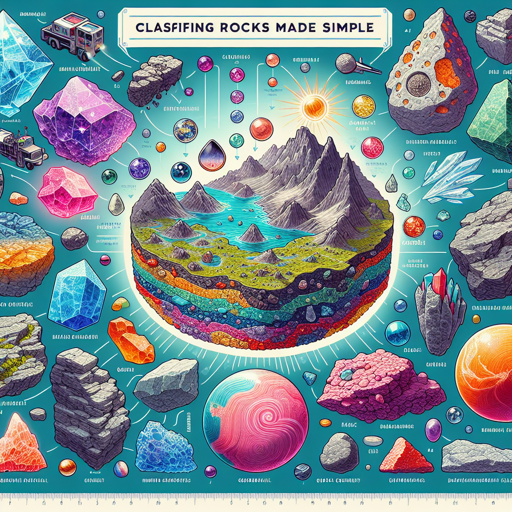
Classifying Rocks Made Simple: A Beginner’s Guide
Understanding the rocks beneath our feet is like unlocking a story millions (or even billions) of years in the making. From the spectacular cliffs that line our coasts to the pebbles in your backyard, every rock has a history and a classification. For geology enthusiasts, students, educators, and curious earth science lovers, rock classification is an essential skill—and it’s easier to start than you might think!
In this guide, we’ll break down the three main types of rocks, explore their key identification features, and provide practical tips and resources for anyone eager to decode the rocky world around them.
Table of Contents
- Why Classify Rocks?
- The Three Main Rock Types
- Key Identification Features
- Rock Classification Table
- Tips for Beginners
- Practical Activities and Fieldwork
- Further Reading & References
- Conclusion
Why Classify Rocks?
Rock classification is the foundation of geology. By understanding rock types and their origins, we can:
- Reconstruct Earth’s history
- Locate valuable resources (minerals, metals, fossil fuels)
- Understand past environments and climates
- Predict geologic hazards
“The best geologist is the one who has seen the most rocks.”
— Herbert Harold Read, eminent British geologist
Whether you’re collecting specimens, teaching earth science, or simply exploring outdoors, knowing how to classify rocks opens a window into Earth’s dynamic processes.
The Three Main Rock Types
All rocks fall into one of three broad categories based on how they form: Igneous, Sedimentary, or Metamorphic. Let’s explore each type.
Igneous Rocks
Formation: Igneous rocks originate from molten magma that cools and solidifies. This can happen beneath the surface (intrusive) or after volcanic eruptions (extrusive).
Key Features:
- Interlocking crystals
- Lack of layering
- Sometimes vesicular (holes from gas bubbles)
- May contain visible mineral grains
Examples: Granite (intrusive), Basalt (extrusive), Obsidian (volcanic glass)
Sedimentary Rocks
Formation: Formed by the deposition and compaction of sediments—bits of other rocks, minerals, or biological material—often in layers.
Key Features:
- Distinct layers (strata)
- Can contain fossils
- Often softer or crumbly
- May show ripple marks or mud cracks
Examples: Sandstone, Limestone, Shale
Metamorphic Rocks
Formation: Created when existing rocks (igneous or sedimentary) are altered by heat, pressure, or chemically active fluids, without melting.
Key Features:
- Foliation (banding or alignment of minerals)
- Harder than original rock
- May have distorted or stretched structures
- Crystalline texture
Examples: Gneiss, Schist, Marble
Key Identification Features
When identifying rocks in the field or in the lab, geologists use several observable features:
| Feature | Description | What it Indicates |
|---|---|---|
| Texture | Size/shape/arrangement of mineral grains | Cooling rate, formation process |
| Color | Overall appearance due to mineral content | Mineralogy |
| Hardness | Resistance to scratching | Mineral composition |
| Structure | Layering (bedding/foliation), banding | Sedimentary vs. metamorphic |
| Fossils | Presence of preserved organisms | Usually sedimentary |
| Vesicles | Holes from gas bubbles | Volcanic igneous |
| Reactivity | Reaction with acid (e.g., fizzing with HCl) | Presence of calcite/limestone |
These features help narrow down the possibilities before consulting a field guide or reference.
Rock Classification Table
Here’s a handy summary table to help beginners recognize and compare the three main rock types:
| Rock Type | Formation Process | Texture/Structure | Common Minerals | Typical Examples |
|---|---|---|---|---|
| Igneous | Cooling of magma/lava | Crystalline (coarse/fine), vesicular | Quartz, Feldspar, Mica | Granite, Basalt |
| Sedimentary | Compaction/cementation of sediments | Layered (bedded), may be clastic or chemical | Calcite, Quartz, Clay | Sandstone, Shale |
| Metamorphic | Alteration by heat/pressure | Foliated (banded) or non-foliated | Garnet, Mica, Quartz | Gneiss, Marble |
Tips for Beginners
Getting started with rock identification can seem daunting, but these tips will make your journey easier:
-
Start with Texture
Is the rock glassy, grainy, layered, or banded? Texture offers big clues. -
Check for Layers or Bands
Layered rocks are often sedimentary; banded/folded ones may be metamorphic. -
Look for Crystals or Fossils
Visible crystals suggest igneous origins; fossils point to sedimentary. -
Test Hardness
Use a fingernail (~2.5), copper penny (~3), steel nail (~5), and glass (~5.5) as simple hardness testers. -
Acid Test for Carbonates
Drop dilute hydrochloric acid (or vinegar) on the rock—fizzing means likely limestone (sedimentary). -
Carry a Field Guide
A good field guide with photos and descriptions is invaluable. -
Practice Observation
The more rocks you examine, the easier it becomes!
Practical Activities and Fieldwork
Exploring rocks hands-on is a fantastic way to reinforce learning and spark curiosity:
- Rock Hunt: Visit local parks, riversides, or quarries—collect different rock samples.
- Create a Rock Collection: Label each specimen with location and observations.
- Magnifying Glass Investigation: Examine grain size and mineral arrangement up close.
- Group Discussion: Compare findings with friends or classmates—debate the origins!
- Classroom Experiments: Try scratch tests, acid tests (with adult supervision), and simple density measurements.
Educators can incorporate these activities into lessons to make geology engaging and interactive.
Further Reading & References
For those eager to dive deeper into rock identification and classification:
- US Geological Survey: Rocks Information
- “Rocks & Minerals” by Chris Pellant (DK Publishing)
- “Manual of Mineral Science” by Cornelis Klein & Barbara Dutrow
- Mindat.org — The Mineral Database
- Local geological society field trips or museums
Conclusion
Rocks are more than just the foundation of our landscapes—they’re the storytellers of Earth’s history. With a grasp of basic classification principles and identification features, anyone can start reading that story in the world around them.
Remember: every great geologist began as an enthusiastic beginner who picked up a stone and asked, “What is this?” With simple tools, careful observation, and a sense of wonder, you’re well on your way to classifying rocks like a pro.
Happy rock hunting!