 Mineral Matrix: An AI Journey into Earth’s Treasures
Women Pioneers Who Shaped Geology and Mineralogy
Celebrating female pioneers who transformed geology, mineralogy, and the study of Earth's treasures
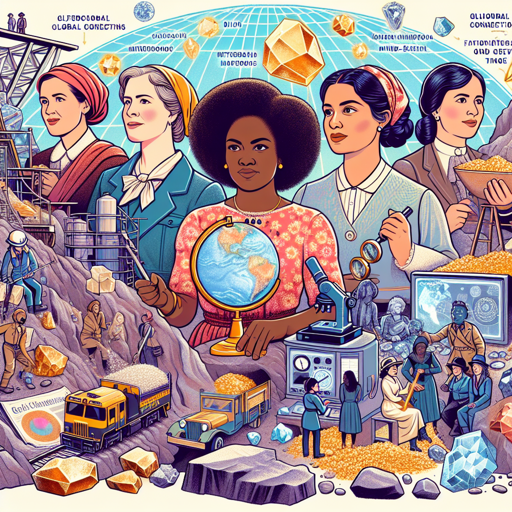
Women Who Changed Geology Forever
Introduction
Geology—the study of Earth’s structure, processes, minerals, and history—has traditionally been dominated by men. Yet, against considerable odds, a remarkable group of women have left indelible marks on the field. Their discoveries, research, and advocacy have shaped our understanding of minerals, rocks, fossils, tectonics, and even the very processes that make our planet dynamic and beautiful. Today, we celebrate these trailblazers whose legacies continue to inspire geology enthusiasts, educators, students, and earth science lovers around the world.
Breaking Barriers: The Early Pioneers
Mary Anning (1799–1847): Fossil Hunter of Lyme Regis
Mary Anning’s story is legendary among geologists and paleontologists. Born into poverty in Lyme Regis on England’s Jurassic Coast, she began fossil hunting as a child to help support her family. Despite lacking formal education and facing barriers as a woman in science, Anning made groundbreaking discoveries—including the first complete Ichthyosaurus and Plesiosaurus skeletons.
Her meticulous observations and fossil finds provided critical evidence for extinction and evolutionary theories. Charles Lyell and Richard Owen, among others, cited her work. Anning’s legacy is immense: she not only expanded the fossil record but also helped reshape geological thinking in the 19th century.
“The world has used me so unkindly, I fear it has made me suspicious of everyone.” — Mary Anning
Florence Bascom (1862–1945): The First Lady of American Geology
Florence Bascom was the first woman to receive a Ph.D. from Johns Hopkins University (1893) and the second woman in the United States to earn a geology doctorate. She became the first female geologist hired by the U.S. Geological Survey.
Bascom’s research on the crystalline rocks of the Appalachian Piedmont set new standards for petrography (the study of rocks via microscope). As a professor at Bryn Mawr College, she trained generations of women geologists who went on to transform the field themselves.
Inge Lehmann (1888–1993): Discoverer of Earth’s Inner Core
Danish seismologist Inge Lehmann shattered previous notions of Earth’s interior. In 1936, analyzing seismic data from earthquakes, she deduced that Earth had a solid inner core distinct from its liquid outer core—a revelation that reshaped our understanding of planetary structure.
Lehmann’s meticulous work, often overlooked by her male contemporaries, is now considered foundational in geophysics and seismology.
Twentieth Century Trailblazers
Marie Tharp (1920–2006): Mapping the Ocean Floor
Marie Tharp was a geologist and cartographer whose work revolutionized oceanography. At Columbia University’s Lamont Geological Observatory in the 1950s, Tharp transformed sonar soundings into the first comprehensive maps of the Atlantic Ocean floor.
Her maps revealed the Mid-Atlantic Ridge’s rift valley—crucial evidence supporting plate tectonics theory. While her male colleagues initially dismissed her interpretations as “girl talk,” Tharp proved correct and is now rightly celebrated as a co-discoverer of seafloor spreading.
Janet Watson (1923–1985): Decoding British Geology
Janet Watson’s pioneering studies on the Scottish Highlands clarified the region’s complex geology. Her research with John Sutton on the Lewisian gneiss helped establish new frameworks for understanding metamorphism and Precambrian rocks.
As the first female president of the Geological Society of London (1982), Watson broke glass ceilings and advocated for women in science.
Katharine Burr Blodgett (1898–1979): Innovator Beyond Geology
Though known for her work in physics and chemistry—she invented non-reflective glass—Katharine Blodgett’s research had significant implications for mineralogy and materials science. Her surface chemistry studies helped advance understanding of mineral surfaces and thin films.
Contemporary Leaders Advancing Geoscience
Lisa Tauxe: Magnetic Insights into Earth’s History
A professor at Scripps Institution of Oceanography, Lisa Tauxe is a leading expert in paleomagnetism—the study of magnetic fields preserved in rocks. Her research helps decode plate tectonics, magnetic reversals, and Earth’s ancient geography.
Tauxe has received numerous accolades and is renowned for mentoring young scientists and promoting gender equality in geosciences.
Marcia McNutt: Leadership at the Helm
Marcia McNutt has held some of the most influential positions in earth sciences. As President of the National Academy of Sciences and former Director of the USGS, McNutt has championed science policy, earthquake response, ocean exploration, and STEM diversity.
Her career exemplifies how women now help drive global scientific agendas.
Table: Notable Women Who Changed Geology
| Name | Contribution | Era | Legacy/Impact |
|---|---|---|---|
| Mary Anning | Fossil discoveries; paleontology | 19th Century | Foundation for evolutionary theory |
| Florence Bascom | Petrography; educator | Early 20th C. | First major female US geologist |
| Inge Lehmann | Earth’s inner core discovery | 20th Century | Revolutionized seismology |
| Marie Tharp | Ocean floor mapping | Mid-20th C. | Plate tectonics; seafloor spreading |
| Janet Watson | Metamorphic geology | Mid-20th C. | Advanced geological mapping |
| Lisa Tauxe | Paleomagnetism | 21st Century | Ancient magnetic field research |
| Marcia McNutt | Science leadership | 21st Century | NAS President; USGS Director |
Barriers Faced and Overcome
Women pioneers in geology faced formidable challenges:
- Institutional discrimination: Many universities excluded women from formal degrees or fieldwork.
- Professional isolation: Early female geologists were often denied membership in scientific societies.
- Lack of recognition: Their contributions were frequently credited to male colleagues or ignored entirely.
Despite these obstacles, these women persisted—publishing papers under their own names, mentoring others, founding professional societies for women in science, and advocating for equality. Their perseverance paved the way for today’s more inclusive geology community.
Why Representation Matters
The stories of these trailblazers underscore why diversity is vital in geology:
- Broader perspectives: Diverse voices fuel creative thinking about Earth’s processes.
- Inspiration: Role models encourage more young people—especially girls—to pursue earth science careers.
- Equity: Recognizing contributions from all backgrounds leads to stronger science and better stewardship of our planet.
“Science progresses best when observations force us to alter our preconceptions.”
— Vera Rubin (Astronomer)
Resources for Further Exploration
- Smithsonian Women in Science
- International Union of Geological Sciences: Women in Geoscience
- Association for Women Geoscientists
For more detailed biographies and stories about women in geology:
Geological Society of London: 100 Great Geologists
Conclusion
From humble fossil hunters to leaders of global scientific institutions, women have always been integral to geology—even when their presence went unacknowledged. Their discoveries have rewritten textbooks, their advocacy has changed institutions, and their passion continues to shape earth science for future generations.
As we explore minerals, mines, gems, and geologic wonders, let us remember these pioneers—and strive to create a geoscience community where everyone is empowered to make history.
Inspired to learn more? Read about other underrecognized figures in earth science or share this article with fellow enthusiasts!