 Mineral Matrix: An AI Journey into Earth’s Treasures
Decoding Geodes The Hidden Marvels of the Earth
Explore the science and allure of geodes, from their formation to their dazzling crystal interiors.
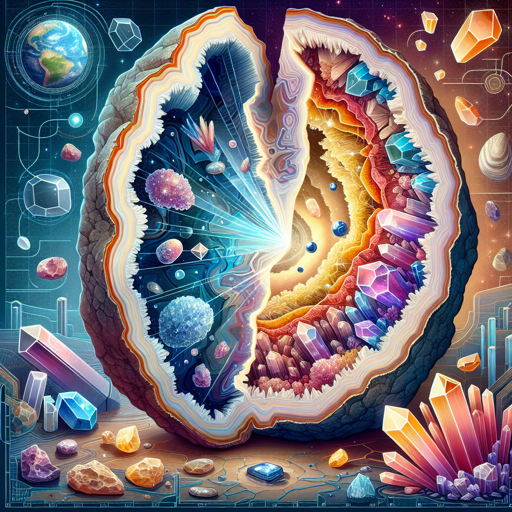
Decoding Geodes and Their Wonders
Introduction
Imagine holding an unremarkable, lumpy rock in your hand. As you crack it open, a hidden world bursts forth—crystals glitter in vibrant purples, blues, and whites, arranged in mesmerizing patterns. This is the magic of the geode: from plain on the outside to extraordinary on the inside, geodes have fascinated geologists, collectors, and rockhounds for centuries. But what are these geological marvels, how do they form, and why do they captivate us so?
In this in-depth exploration, we’ll journey into the heart of geodes. We’ll uncover their formation processes, delve into their mineral treasures, examine their scientific and cultural significance, and guide you on identifying and collecting these natural wonders. Whether you’re a seasoned geologist or simply enchanted by the world beneath our feet, prepare to be dazzled by the hidden beauty of geodes.
The Birth of a Geode: Nature’s Geological Surprise
Geodes are spherical to subspherical rocks with hollow cavities lined with crystals or mineral matter. Their formation is a tale of patience spanning millions of years—an interplay of geological processes that transforms the ordinary into the extraordinary.
How Geodes Form
-
Cavity Creation:
Geode formation begins with a void inside a rock. This void can arise through several mechanisms:- Gas bubbles in volcanic rock (like basalt) as lava cools.
- Dissolution of nodules or fossils (such as tree roots or shells) in sedimentary rock, leaving behind empty spaces.
-
Mineral-rich Solution Infiltration:
Water containing dissolved minerals seeps into the cavity through porous rock or microfractures. Over time, changes in temperature, pressure, or chemistry cause these minerals to precipitate out of solution. -
Crystallization:
As minerals like quartz, calcite, or amethyst slowly deposit along the interior walls, crystals begin to grow inward. This growth continues—sometimes for hundreds of thousands of years—until the cavity is lined with a dazzling crystal display. -
The Final Geode:
The outer shell remains drab and unassuming, protecting the vibrant secret within until it is revealed by nature or human hands.
“Geodes remind us that beauty often lies hidden beneath the surface—waiting for discovery by those curious enough to look.”
—Dr. Maria Celestino, Mineralogist
What’s Inside? The Mineralogical Diversity of Geodes
The inner world of a geode can be astonishingly diverse. The specific minerals found depend largely on the local geology and the chemistry of the infiltrating solutions.
| Mineral | Color(s) | Common Locations | Crystal Form | Formation Environment |
|---|---|---|---|---|
| Quartz | Clear, white, purple | Brazil, Uruguay, USA | Prismatic/Drusy | Volcanic & sedimentary |
| Amethyst | Purple | Brazil, Uruguay | Prismatic/Cluster | Silica-rich volcanic lava |
| Calcite | White, yellow, orange | Mexico, USA | Scalenohedral | Sedimentary limestone |
| Celestite | Blue | Madagascar, Ohio (USA) | Tabular/Prismatic | Sedimentary evaporite |
| Agate | Banded multi-colors | Brazil, Mexico | Microcrystalline | Volcanic rocks |
| Chalcedony | Gray, blue, pink | Worldwide | Botryoidal | Silica-rich fluids |
| Gypsum | White, clear | Mexico | Tabular/Needle | Evaporite deposits |
| Pyrite | Gold | Spain, Peru | Cubic | Hydrothermal |
Spectacular Crystal Formations
- Amethyst Geodes: Known for their deep purple hues and impressive sizes (some large enough to stand inside!), amethyst-lined geodes are among the most prized by collectors.
- Agate Geodes: These often display intricate banding patterns in various colors due to alternating layers of microcrystalline quartz.
- Celestite Geodes: With sky-blue crystals, celestite geodes are visually striking and relatively rare.
Why Are Geodes So Captivating?
1. The Element of Surprise
The contrast between a geode’s plain exterior and its stunning interior never fails to amaze. Every geode is unique—a geological lottery ticket waiting to be opened.
2. Scientific Value
Geodes offer geologists a natural laboratory for studying mineral formation. Their interiors record millions of years of geological history in crystal growth patterns and mineral layers.
3. Educational Impact
For educators and students alike, geodes are tangible examples of earth science concepts such as mineral crystallization, rock cycles, and groundwater chemistry.
4. Cultural and Spiritual Significance
Across cultures and centuries, geodes have been regarded as symbols of hidden potential and inner beauty. Some believe their crystals hold metaphysical properties for healing and meditation.
Famous Geode Localities Around the World
Some regions are renowned for yielding particularly impressive or abundant geodes:
- Brazil & Uruguay: Home to massive amethyst geodes found in volcanic basalt flows.
- Mexico: Notable for “coconut” geodes with quartz and agate.
- Iowa (USA): The Keokuk area is famous for small but highly varied quartz and calcite geodes.
- Indiana (USA): Limestone deposits yield abundant geodes with clear quartz interiors.
- Madagascar: Source of large celestite geodes.
Table: Comparison of Major Geode-Producing Regions
| Region | Dominant Minerals | Notable Features |
|---|---|---|
| Brazil/Uruguay | Amethyst, Quartz | Gigantic geodes, deep coloration |
| Mexico | Agate, Quartz | Colorful banding (“coconut” geodes) |
| Iowa | Quartz, Calcite | Highly varied interiors |
| Indiana | Quartz | Abundant and accessible |
| Madagascar | Celestite | Large blue crystals |
How to Identify and Collect Geodes
Spotting a Geode in the Wild
- Shape: Most geodes are roughly spherical or oval with a lumpy exterior.
- Weight: They tend to be lighter than solid rocks due to their hollow interiors.
- Texture: The outer surface is typically rough and sometimes covered with a thin layer of limestone or clay.
- Sound: When shaken gently, some geodes may rattle if loose crystals are inside.
Ethical Collecting Tips
- Always seek permission before collecting on private land.
- Follow local regulations and practice responsible collecting—take only what you need.
- Leave no trace: restore disturbed ground and avoid damaging the environment.
Opening Geodes Safely
- Score-and-Snap Method: Use a specialized geode cracker or gently score around the circumference with a chisel before tapping it open.
- Sawing: For prized specimens, a diamond saw ensures a clean cut and preserves crystal structure.
- Protective Gear: Always wear goggles and gloves when breaking open rocks.
Geodes in Research and Industry
Geodes aren’t just collector’s items; they have scientific value:
- Paleoenvironments: Interior mineral layers provide clues about ancient groundwater chemistry and environmental conditions.
- Crystallography: Large crystals give researchers insight into mineral growth rates and conditions.
- Gem Industry: Amethyst from geodes is widely used in jewelry; polished geode slices are popular decorative items.
Geodes in Education: A Hands-On Earth Science Tool
For educators, geodes offer an engaging way to introduce geology concepts:
- Classroom Demonstrations: Cracking open a geode captivates students’ attention.
- Lessons on Mineralogy: Students can identify minerals by color, crystal form, and hardness.
- Earth Processes: Demonstrate rock cycles and mineral deposition using real-world examples.
“Nothing ignites curiosity quite like revealing the sparkling heart of a geode in front of a classroom.”
—Sarah Jensen, Earth Science Teacher
External Reference
For more information on geode formation and mineralogy: Smithsonian National Museum of Natural History – Geology
Conclusion
Geodes are more than just pretty rocks—they are geological time capsules that tell stories of ancient volcanic eruptions, groundwater flows, and slow mineral growth deep beneath our feet. Their allure lies not only in their hidden splendor but also in what they teach us about patience, transformation, and the wonders that await discovery within the Earth.
Whether you’re an avid collector, a curious student, or someone simply enchanted by nature’s artistry, exploring geodes opens a window into both science and beauty. Next time you encounter a dull round stone on a hike or at a rock show, remember: you might be holding a secret world waiting to be revealed.
Happy rock hunting! If you have your own geode stories or photos to share, leave a comment below or join our community on Galena’s forums. Keep exploring—the next geological marvel might be just beneath your feet!