 Mineral Matrix: An AI Journey into Earth’s Treasures
From Ore to Metal Understanding Extraction
Explore how metals journey from raw ore to refined products in mining.
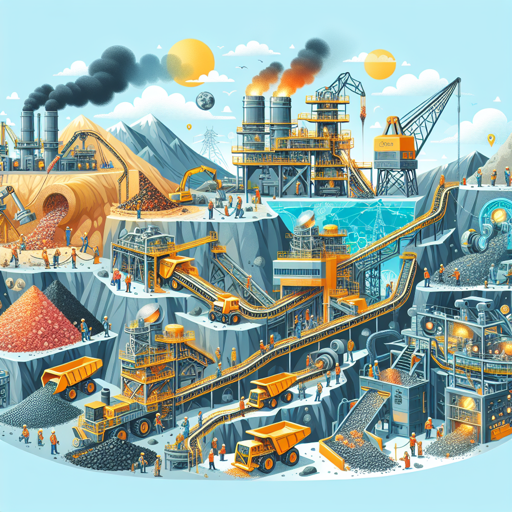
From Ore to Metal: The Extraction Process Unveiled
Metals are all around us—from the copper in electrical wiring to the gold in jewelry and electronics, to the iron making up the framework of our cities. But have you ever wondered how these vital elements make their way from deep within the Earth’s crust into forms we use every day? The journey from raw ore to refined metal is a remarkable story of geology, engineering, chemistry, and human ingenuity.
In this article, we’ll embark on a deep dive into the extraction process of metals, breaking down each step in simple terms. Whether you’re a geology enthusiast, educator, student, or simply curious about the world beneath your feet, this guide will illuminate the fascinating transformation from ore to metal.
Table of Contents
- What Is an Ore?
- Mining: Extracting Ore from the Earth
- Ore Processing: Crushing and Grinding
- Concentration: Separating Valuable Minerals
- Extracting the Metal: Smelting and Refining
- Environmental Considerations
- Comparative Table: Key Metal Extraction Processes
- Conclusion
- Further Reading
What Is an Ore?
An ore is a naturally occurring material containing one or more valuable minerals, typically metals, that can be extracted profitably. Ores are distinguished from ordinary rocks by their concentration of valuable elements.
Common metal ores include:
- Hematite (Fe₂O₃) for iron
- Bauxite (Al(OH)₃ and AlO(OH)) for aluminum
- Chalcopyrite (CuFeS₂) for copper
- Galena (PbS) for lead
- Cassiterite (SnO₂) for tin
The formation of ores is heavily influenced by geological processes such as magmatic differentiation, hydrothermal activity, sedimentation, and metamorphism.
Mining: Extracting Ore from the Earth
The first step in the journey from ore to metal is mining—the physical removal of ore from the ground. Mining methods vary depending on ore type, deposit geometry, depth, and surrounding rock.
Major Mining Methods
-
Surface Mining
- Open-pit mining: Used for large, near-surface deposits.
- Strip mining: Common for coal or layered deposits.
- Placer mining: Extracts minerals from alluvial deposits.
-
Underground Mining
- Room and pillar mining
- Cut and fill mining
- Block caving
Each method aims to maximize ore recovery while minimizing environmental impact and ensuring miner safety.
Ore Processing: Crushing and Grinding
Once extracted, the ore is transported to a processing plant where it undergoes:
- Crushing: Reduces large chunks of ore into manageable pieces.
- Grinding: Further reduces particle size to liberate minerals from waste rock (gangue).
This mechanical treatment prepares the ore for subsequent concentration processes.
Concentration: Separating Valuable Minerals
Raw ore contains not only valuable minerals but also unwanted material (gangue). To extract metals efficiently, ores must be concentrated.
Common Concentration Techniques
| Method | Principle | Typical Use |
|---|---|---|
| Gravity Separation | Density differences | Gold, tin, tungsten |
| Flotation | Surface chemistry | Copper, lead, zinc |
| Magnetic Separation | Magnetic properties | Iron |
| Leaching | Solubility differences | Gold (cyanide), uranium |
These processes increase the percentage of valuable metals in the concentrate before extraction.
Extracting the Metal: Smelting and Refining
With concentrated ore in hand, the next step is extracting pure metal—a process that varies by metal and ore type.
1. Pyrometallurgy (Heat-Based Methods)
Smelting is the foundational pyrometallurgical process. It involves heating concentrated ore with a reducing agent (like coke) to drive off unwanted elements as gases or slag, leaving behind molten metal.
Example: Iron Extraction
- Blast Furnace: Iron ore (hematite), coke, and limestone are added.
- Chemical reactions reduce iron oxide to liquid iron.
- Impurities form slag, which floats atop molten iron and is removed.
2. Hydrometallurgy (Solution-Based Methods)
Metals like copper or gold can be extracted using chemical solutions that dissolve the desired metal from its ore.
Example: Gold Leaching
- Crushed ore is treated with a cyanide solution.
- Gold dissolves and is later recovered via precipitation or adsorption.
3. Electrometallurgy
Some metals, such as aluminum and copper, are further purified by passing an electric current through a solution or molten compound containing the metal (electrolysis).
Example: Aluminum Extraction
- Bauxite is refined to alumina (Al₂O₃).
- Alumina is dissolved in molten cryolite.
- Electrolysis splits alumina into aluminum metal and oxygen gas.
“Mining is as much about chemistry as it is about geology—understanding both enables us to unlock Earth’s treasures responsibly.”
— Dr. Sarah Jensen, Mineral Processing Specialist
Environmental Considerations
Metal extraction has significant environmental impacts—from landscape disruption during mining to air and water pollution during processing.
Key Concerns
- Tailings: Residues left after concentration often contain toxic substances.
- Acid Mine Drainage: Sulfide minerals react with air/water to produce acidic runoff.
- Air Emissions: Smelting releases sulfur dioxide and other gases.
- Energy Use: Some extraction processes are highly energy-intensive (e.g., aluminum).
Modern mining aims to mitigate these impacts through reclamation, pollution control technologies, recycling efforts, and sustainable practices.
Comparative Table: Key Metal Extraction Processes
| Metal | Main Ore | Concentration Method | Extraction Process | Environmental Challenge |
|---|---|---|---|---|
| Iron | Hematite | Magnetic separation | Blast furnace smelting | CO₂ emissions |
| Copper | Chalcopyrite | Flotation | Roasting & leaching | Acid mine drainage |
| Aluminum | Bauxite | Bayer process | Electrolysis | High energy use |
| Gold | Native/veins | Gravity/flotation | Cyanide leaching | Toxic tailings |
| Zinc | Sphalerite | Flotation | Roasting & electrolysis | Heavy metal contamination |
Conclusion
The journey from ore to metal is both ancient and ever-evolving—a testament to human curiosity and ingenuity. By understanding each stage—from identifying valuable ores to extracting pure metals—we gain not only an appreciation for the materials shaping our world but also insight into responsible resource use for future generations.
Whether you’re marveling at a gemstone, teaching geology in a classroom, or simply holding a metal object in your hand, remember the incredible voyage it has made from deep within our planet to you.
Further Reading
For more detailed information on mineral extraction and metallurgy:
Stay curious—explore more about minerals, mining, and gemstones with us!