 Mineral Matrix: An AI Journey into Earth’s Treasures
Tracing the Journey of Gemstone Mining History
Explore how gemstone mining evolved from ancient hand tools to modern sustainable methods.
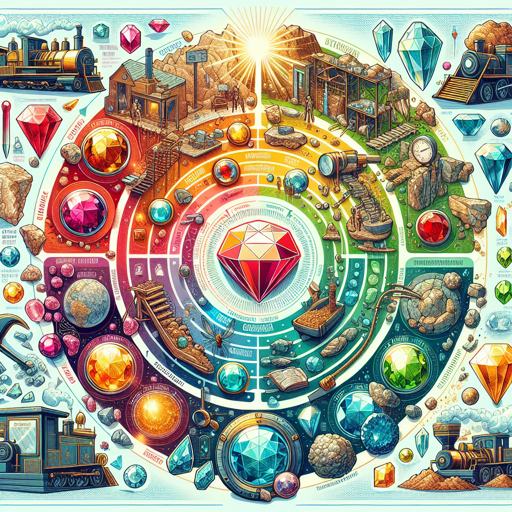
The Evolution of Gemstone Mining: From Ancient Quarries to Modern Marvels
Gemstones have captivated human imagination for millennia. From the deep blues of sapphires to the fiery brilliance of rubies and diamonds, these treasures of the earth have shaped cultures, economies, and legends. But behind every dazzling jewel lies a story of discovery, innovation, and endurance—one etched into the history of gemstone mining.
In this in-depth exploration, we trace the fascinating journey of gemstone mining. From primitive beginnings and ancient trade routes to the high-tech, sustainable practices of today, gemstone mining’s evolution reveals not only our changing relationship with earth’s resources but also the ingenuity and resilience of those who seek its hidden wonders.
1. The Dawn of Gemstone Discovery
Ancient Curiosity and Early Tools
Long before written history, early humans stumbled upon brightly colored pebbles in riverbeds and rocky outcrops. These first gemstones were likely collected for their beauty or mystical properties rather than adornment or trade. Archaeological evidence from sites such as Mehrgarh in Pakistan (dating back to 7000 BCE) shows the use of lapis lazuli beads, hinting at some of the earliest organized gemstone gathering.
Early Mining Methods
Primitive mining was a laborious affair. Without metal tools or explosives, early miners relied on:
- Hand picking: Collecting loose gems from river gravels and streambeds.
- Simple digging tools: Bones, wooden sticks, and later, rudimentary stone hammers.
- Fire-setting: A technique where fires were built against rock faces to crack them open by rapid heating and cooling.
These methods restricted miners to surface deposits and shallow pits, limiting both depth and yield.
Trade and Cultural Significance
As societies developed, gemstones began appearing in burial sites, religious artifacts, and royal regalia. The use of turquoise in Ancient Egypt (from mines in Sinai), jade in China, and garnet across Europe illustrates how early mining sparked far-reaching trade networks.
“The love of gems is as old as mankind… they have been cherished by all civilizations and have shaped the course of human history.”
— George Frederick Kunz, Gemologist
2. The Classical Era: Organization and Expansion
Ancient Egypt and Mesopotamia
By 3000 BCE, Egyptians had established some of the world’s first organized gemstone mines. The famed turquoise mines of Wadi Maghareh in Sinai used stone hammers and copper chisels. Labor was often supplied by slaves or prisoners.
Greco-Roman Innovations
The Roman Empire’s appetite for luxury drove expansion into remote regions for emeralds (Egypt), sapphires (Sri Lanka), and more. Romans introduced new mining techniques:
- Quarrying: Systematic extraction from bedrock using iron tools.
- Shafts and galleries: Digging deeper via vertical shafts and horizontal tunnels.
- Water-driven machinery: Water wheels powered pumps to remove groundwater from deeper mines.
The Silk Road and Beyond
Trade routes like the Silk Road spread gemstones—including rubies from Burma (Myanmar) and spinels from Afghanistan—across continents. Gemstones became symbols of power, currency, and diplomacy.
3. Medieval to Renaissance Mining: Secrets and Guilds
European Advancements
Medieval Europe saw the rise of mining guilds—groups that guarded secret locations and extraction techniques. The famous Bohemian garnet mines illustrate the transition:
- Improved safety: Timber supports to prevent tunnel collapses.
- Ventilation shafts: To provide fresh air underground.
- Washing tables: For sifting gem gravels efficiently.
Asia’s Gem Empires
India’s Golconda region became synonymous with legendary diamonds (including the Koh-i-Noor), mined via open pits and primitive tunnels. In Sri Lanka, traditional “pit mining” for sapphires involved digging deep vertical wells in gem-rich alluvial soil—a method still used today.
4. The Industrial Revolution: Mechanization Arrives
Technological Leaps
The 18th and 19th centuries saw radical changes:
- Explosives: Use of black powder (and later dynamite) allowed miners to shatter hard rock efficiently.
- Steam-powered pumps: Drained water from deep shafts.
- Mechanical sorting: Early machines separated gemstones from ore.
These innovations allowed access to richer deposits at greater depths.
Notable Discoveries
- Kimberley Diamond Mine (South Africa, late 1800s): The world’s largest hand-dug excavation. Sparked a diamond rush and global market.
- Montana Sapphires (USA): Hydraulic mining used high-pressure water jets to break down gravel banks.
Environmental Impact
Industrial mining often left lasting scars—deforestation, soil erosion, polluted waterways—prompting later generations to seek more sustainable methods.
5. Modern Gemstone Mining: Technology Meets Responsibility
High-Tech Methods
Today’s gemstone mining is a blend of tradition and innovation:
| Era/Method | Tools/Techniques | Yield & Depth | Environmental Impact |
|---|---|---|---|
| Ancient | Hand tools, fire-setting | Shallow/Low | Minimal |
| Classical | Iron tools, simple shafts | Moderate | Localized |
| Industrial | Explosives, steam machines | Deep/High | High |
| Modern | Drones, X-ray sorting, eco-mining | Deep/High | Managed/Sustainable |
Key Modern Technologies
- Remote sensing & drones: Map deposits without disturbing landscapes.
- X-ray fluorescence (XRF): Detects gemstones in ore on conveyor belts.
- Laser cutting & sorting: Reduces waste; increases recovery rates.
- Closed-loop water systems: Recycle water used for washing gravels.
Ethical & Sustainable Mining
Societal attitudes have shifted towards ethical sourcing:
- Fairtrade practices: Ensure miners receive fair wages and work in safe conditions.
- Traceability: Blockchain technology certifies origin for “conflict-free” gems.
- Reclamation: Mining companies now restore sites post-extraction with native vegetation or create eco-tourism attractions.
Women & Community in Mining
Modern initiatives empower local communities, especially women—providing education, healthcare, and alternative livelihoods.
6. Challenges Ahead: Balancing Beauty With Responsibility
While technology has addressed many operational challenges, gemstone mining still faces:
- Illegal/Artisanal Mining: Unregulated digging can fuel conflict or environmental harm.
- Climate Change: Changes in rainfall patterns impact alluvial deposits.
- Resource Depletion: Some famed mines are exhausted or protected as heritage sites.
Toward a Sustainable Future
The future lies in balancing demand with stewardship—emphasizing:
- Recycling gems from vintage jewelry
- Supporting laboratory-grown alternatives
- Investing in education for miners about environmental care
Table: Comparing Ancient vs. Modern Gemstone Mining
| Aspect | Ancient Mining | Modern Mining |
|---|---|---|
| Tools | Stone/bone implements | Drones, XRF scanners |
| Depth | Surface/shallow | Deep (hundreds of meters) |
| Labor | Manual/human | Mechanized + skilled operators |
| Environmental Impact | Low | Managed/Sustainable |
| Ethical Considerations | None | High (fair trade, traceability) |
| Yield | Low | High |
External Reference
For a deeper dive into gemstone mining’s evolution and its global impact, visit the Gemological Institute of America (GIA).
Conclusion: Gems That Tell Stories
The story of gemstone mining is one of adaptation—shaped by technology, culture, ethics, and ever-changing landscapes. From ancient miners scraping earth with bare hands to today’s engineers wielding digital tools and environmental stewardship, each era has left its mark on both ground and society.
For geology enthusiasts and earth science lovers alike, understanding this evolution not only illuminates the beauty within each gem but also reminds us that every sparkling stone is a chapter in humanity’s ongoing quest to unlock the earth’s secrets—responsibly and sustainably.
Whether you’re studying mineralogy, teaching geology, or simply marveling at a brilliant jewel, remember that its journey through time is as captivating as its luster.